Choosing between the PMI-RMP vs PMP (PMI Risk Management Professional & Project Management Professional) is one of the most consequential credentialing decisions a project or risk professional can make. And it is also one of the most frequently mishandled.
The internet offers no shortage of side-by-side comparisons. Requirements, exam lengths, passing rates, formatted into tables and positioned as decision support. What those comparisons fail to provide is a framework. A structured method for translating credential data into a career decision rooted in where you are now and where organizational risk demands are headed.
This article is that framework. It is grounded in PMI’s published data, current 2026 exam content outlines, and the performance patterns observed across hundreds of certification candidates.
Why the PMI-RMP vs PMP Comparison Matters Now
PMI’s certification ecosystem has expanded materially. The 2026 PMP Exam Content Outline reflects an updated balance between predictive and agile delivery. The PMI-RMP continues to deepen its emphasis on risk leadership, behavioral risk response, and probabilistic analysis at the portfolio level. Organizations are simultaneously raising their expectations for risk competency across project functions.
In that environment, selecting the wrong credential sequence is not a neutral decision. It carries direct opportunity cost—time, capital, and professional positioning that cannot be easily recovered.

The Credential Specifications: An Honest Comparison
Before applying any framework, practitioners should understand the eligibility and structural differences between the two credentials.
PMP® Eligibility (2026 ECO)
- 35 contact hours of project management education
- 24 to 60 months of non-overlapping project leadership experience within the past 10 years (requirement varies by educational attainment)
- 180 questions | 230 minutes
- Exam fee: $425 (PMI member) / $675 (non-member)
PMI-RMP® Eligibility(2023 ECO)
- 30 to 40 hours of risk management education (requirement varies by educational attainment)
- 12 to 36 months of specialized risk management experience within the past 5 years
- 115 questions | 150 minutes
- Exam fee: $520 (PMI member) / $670 (non-member)
The critical distinction is not in volume of experience but in type. The PMP requires demonstrated project leadership. The PMI-RMP requires demonstrated risk management practice, not project participation, not risk register ownership, but active engagement with risk identification, analysis, response planning, and monitoring processes across the project lifecycle.
On exam format, shorter does not mean simpler. Ninety percent of candidates who have completed both exams report greater mental fatigue after the PMI-RMP’s 115 questions than after the PMP’s 180. The PMI-RMP probes depth of risk competency at a level that most generalist project management education does not reach.
Consider this calibration point: the PMP requires 35 hours of project management education to cover the entirety of project delivery. The PMI-RMP requires 30 to 40 hours to cover risk management alone. That differential reflects the density of the domain.
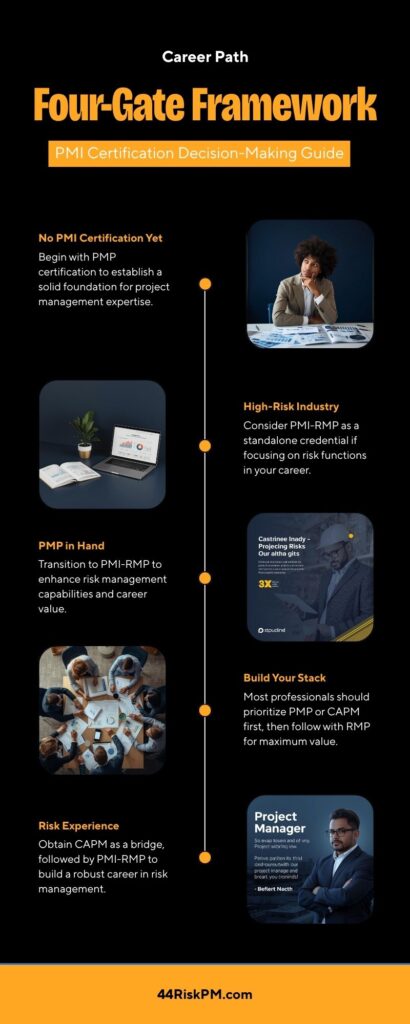
The Four-Gate Decision Framework
Career stage and specialization intent determine which credential to pursue first. The following framework applies to the four most common professional profiles encountered in PMI certification planning.
Gate A: No PMI Certification, Entering Project Management
The correct credential sequence begins with the PMP. There are no exceptions at this gate. The PMI-RMP curriculum presupposes fluency in the foundational language of project management: performance domains, process integration, stakeholder dynamics, and delivery methodology. Attempting to build risk specialization on top of an absent project management foundation produces gaps that surface in both the exam and professional practice.
PMI’s own curriculum architecture reflects this sequence. Risk management in the PMBOK Guide and in the PMI-RMP ECO is situated within a broader project structure—not in isolation from it.
Gate B: PMP in Hand, Operating in a Risk-Intensive Environment
This is the highest-value gate for PMI-RMP pursuit. The PMP has established baseline project management credibility. When a practitioner is now managing high-consequence programs—defense contracts, infrastructure development, healthcare delivery, financial services—the PMI-RMP closes the gap between generalist PM competency and specialist risk leadership.
The credential signals to executive stakeholders and hiring decision-makers that this professional does not merely track risks. They lead the organization’s response to uncertainty. PMI salary data corroborates this: professionals holding multiple PMI credentials consistently outperform single-credential holders in compensation and career advancement.
The PMP-to-RMP stack is the power combination in this profession. Practitioners at Gate B should pursue it without hesitation.
Gate C: Significant Risk Experience, No PMI Credential
This profile is more nuanced. The practitioner has the risk experience to meet PMI-RMP eligibility, but lacks the project management foundation that the RMP curriculum assumes.
The recommended path: CAPM as a bridge credential, followed by the PMI-RMP. The Certified Associate in Project Management carries a lower experience threshold than the PMP while delivering the PMI framework necessary to contextualize risk management within project structure. It is not a consolation path—it is a sequenced investment designed to prevent the foundational gaps that compromise RMP exam performance and post-certification practice.
Gate D: High-Risk Industry, No Defined PM Career Path
The PMI-RMP can function as a standalone credential for risk professionals whose career trajectory is explicitly in risk functions rather than generalist project management. In specialized risk roles—enterprise risk management, program risk analysis, risk consulting—the PMI-RMP alone carries meaningful market differentiation.
The condition for this path: the practitioner must be able to clearly articulate why the PMI-RMP serves their specific professional context and confirm that the PMP’s generalist PM credential does not align with their role requirements. For most professionals evaluating this framework, the answer remains the same: PMP or CAPM first, then RMP.
The Strategic Case for the Certification Stack
PMI’s position on multi-credentialing is grounded in performance data, not marketing. Professionals holding multiple PMI certifications demonstrate measurably higher outcomes in project performance, stakeholder confidence, and career advancement. The PMP establishes competency. The PMI-RMP establishes specialization. Together, they represent a deliberate career investment rather than a reactive compliance decision.
Risk management has evolved from a documentation function into a leadership discipline. Organizations in every high-consequence industry—defense, energy, construction, healthcare, financial services are investing in risk capability at the project and program level. The PMI-RMP positions its holders to lead that function. The PMP positions them to lead projects. The stack positions them to lead both.
Implementation Note
Watch the full breakdown of this framework, including exam structure details and credential sequencing rationale, in the video linked below. For practitioners pursuing the PMI-RMP, the PMI-RMP Exam Content Outline breakdown is available in the next video in this series.
Download the free PMI-RMP Exam Blueprint: https://forty-four-pm.kit.com/rmp-exam-blueprint
Explore PMI-RMP cohort programs at 44riskpm.com: https://rmp.44riskpm.com/Rmp-course-dates
About 44Risk PM, LLC
This analysis was prepared by 44Risk PM LLC, specializing in PMI-RMP® and PMP® certification training with a focus on practical, real-world risk management.
Contact:
Russ Parker
PMP®, PMI-RMP®, PMI-ACP®
PMI-ATP Instructor – PMP® & PMI-RMP®
Owner, Forty-Four Risk PM, LLC
Connect with me on Linkedin
Subscribe to my YouTube
“Stay Proactive Over Reactive”