If you’ve been scrolling LinkedIn lately, you’d think the PMP® certification exam just became a battlefield.
“Take it now before it changes.”
“The new PMBOK is a mess.”
“AI is taking over the exam.”
Let’s slow this down.
The Project Management Institute (PMI) updates its standards and exams on a regular cycle. The release of the PMBOK® Guide – 8th Edition and the updated PMP® Exam Content Outline (ECO) isn’t chaos.
It’s evolution.
And if you understand what’s actually changing — and what isn’t — you can position yourself ahead of 82% of project professionals who are still thinking tactically instead of strategically.
In this article, you’ll learn:
What’s really changing with the PMP certification
What the PMBOK 8th Edition actually means for you
How AI is influencing the profession (without replacing you)
Whether you should rush your exam date
How to prepare strategically for the next phase of the PMP
Let’s break it down.
1. The Release of the PMBOK® Guide – 8th Edition
Project Management Institute has released the PMBOK® Guide – 8th Edition, and yes — like every edition before it — critics immediately found formatting issues and stylistic quirks.
Here’s what matters:
The PMBOK is not a study guide.
It is a reference standard.
It exists to define principles, performance domains, and evolving best practices — not to spoon-feed exam questions.
If you’ve studied previous editions, you’ve seen this before. Each release reflects how project work is changing in the real world. The 8th Edition continues the shift toward:
Value delivery over checklist execution
Strategic alignment over rigid process adherence
Adaptability over documentation overload
If you’re studying with a structured prep program, the transition is not something to fear. It’s something to understand.
The exam does not test your ability to memorize pages of a standard. It tests your ability to apply principles in real-world situations.
And that’s exactly where the profession is heading.
2. The New PMP® Certification Exam Content Outline (ECO)
This is the part most candidates misunderstand.
The PMP exam is driven by the Exam Content Outline (ECO) — not directly by the PMBOK.
The new ECO reflects years of feedback and industry evolution. It continues emphasizing:
People leadership
Business environment awareness
Agile and hybrid approaches
Real-world decision-making
This aligns with PMI’s broader push toward business acumen.
According to PMI’s 2025 Pulse of the Profession®, only 18% of project professionals demonstrate high business acumen — yet those professionals significantly outperform their peers in meeting business goals, schedule, and budget adherence.
That statistic should tell you something.
The PMP isn’t getting harder.
It’s getting more executive.
3. The Integration of Artificial Intelligence
Project Management Institute has also introduced the CPMAI™ credential and published guidance like Leading AI Transformation: Organizational Strategies for Project Professionals, signaling something important:
AI is not optional in the future of project leadership.
But let’s clarify something immediately.
AI is not replacing project managers.
It’s amplifying strategic ones.
AI tools can:
Analyze risk patterns
Improve forecasting accuracy
Optimize resource allocation
Surface stakeholder insights
But AI cannot:
Navigate organizational politics
Align executive expectations
Manage perception
Deliver contextual value
The PMP exam is evolving to reflect this reality. Project managers must understand AI’s impact, but more importantly, they must understand how to lead in an AI-enabled environment.
The winners will not be the most technical.
They will be the most strategic.
4. The “MORE” Shift — This Is the Real Change
PMI has introduced a broader definition of project success: value delivered that was worth the effort and expense.
That mindset is captured in what PMI describes as the “MORE” approach:
M – Manage perceptions of stakeholders
O – Own project success beyond deadlines
R – Relentlessly reassess parameters
E – Expand perspective to enterprise value
This is the real evolution.
The PMP is shifting from:
“Can you follow a process?”
to
“Can you deliver strategic value in complex environments?”
If you prepare only at the process level, you’ll struggle.
If you prepare at the mindset level, you’ll thrive.

Should You Rush to Take the Exam?
Short answer: No.
Long answer: It depends on your timeline and readiness.
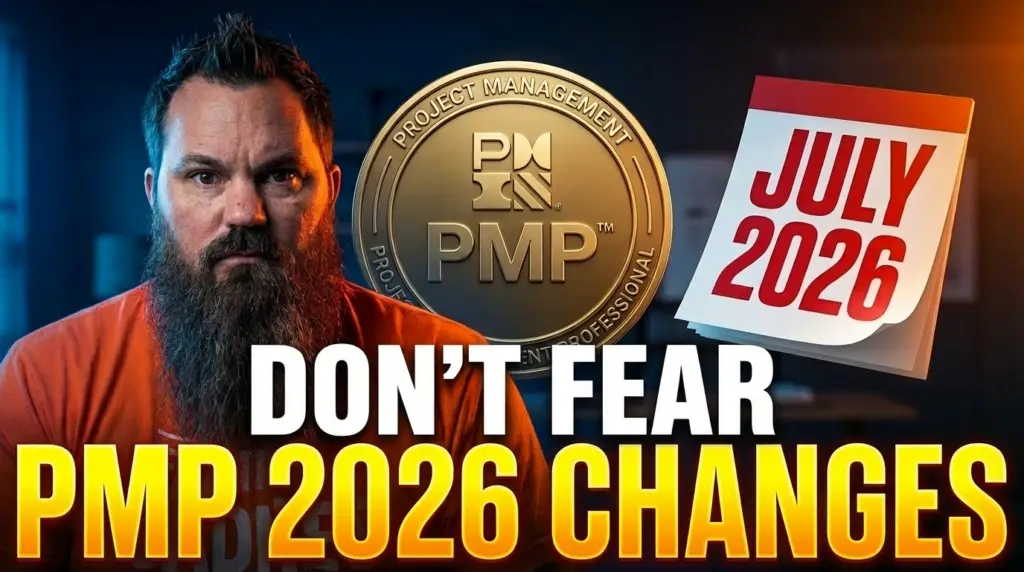
If you planned to test before July 2026:
Stay on your plan. Don’t let fear marketing derail you.
If you’re testing after that:
Start aligning with the updated mindset now. The materials reflecting the new structure will be available well before the transition.
The worst reason to schedule your PMP is panic.
The best reason is preparation.
Be cautious of anyone using urgency as a sales tactic. PMI updates enhance relevance — they do not destroy certification value.
What This Means for Your PMP Strategy
Here’s the practical takeaway:
Focus on application, not memorization.
Develop business acumen alongside technical knowledge.
Understand AI’s role in project environments.
Prepare for scenario-based thinking.
Train with instructors who stay aligned with PMI updates.
The PMP certification remains the gold standard in project leadership. What’s changing is the level of strategic thinking expected.
That’s not a threat.
That’s an opportunity.
The Bottom Line
The PMP exam is not becoming chaotic.
It is becoming more aligned with how projects actually succeed today:
Cross-functional
Value-driven
AI-supported
Stakeholder-intensive
Strategy-connected
The professionals who embrace this shift will stand out.
The ones who resist it will feel overwhelmed.
You get to decide which group you’re in.
The PMP isn’t changing to make your life harder.
It’s evolving to make your credential more powerful.
Prepare strategically.
Lead confidently.
And when you’re ready….. I’ll see you in training.
Use the button below to see my upcoming PMP® Exam Prep Course Schedule.
About 44Risk PM, LLC
This analysis was prepared by 44Risk PM LLC, specializing in PMI-RMP® and PMP® certification training with a focus on practical, real-world risk management.
Contact:
Russ Parker
PMP®, PMI-RMP®, PMI-ACP®
PMI-ATP Instructor – PMP® & PMI-RMP®
Owner, Forty-Four Risk PM, LLC
An Approved PMI-Authorized Training Partner
Connect with me on Linkedin
Subscribe to my YouTube
Find me on Substack
“Stay Proactive Over Reactive”
“The PMI-Authorized Training Partner seal, PMP®, PMI-RMP®, and PMI-ACP® are registered marks of the Project Management Institute, Inc.”