
Picture this: You’re three months into what should have been a straightforward software rollout. Your timeline is solid, your team is brilliant, and leadership signed off months ago. Yet somehow, you’re stuck in meeting hell, watching the same issues resurface week after week.
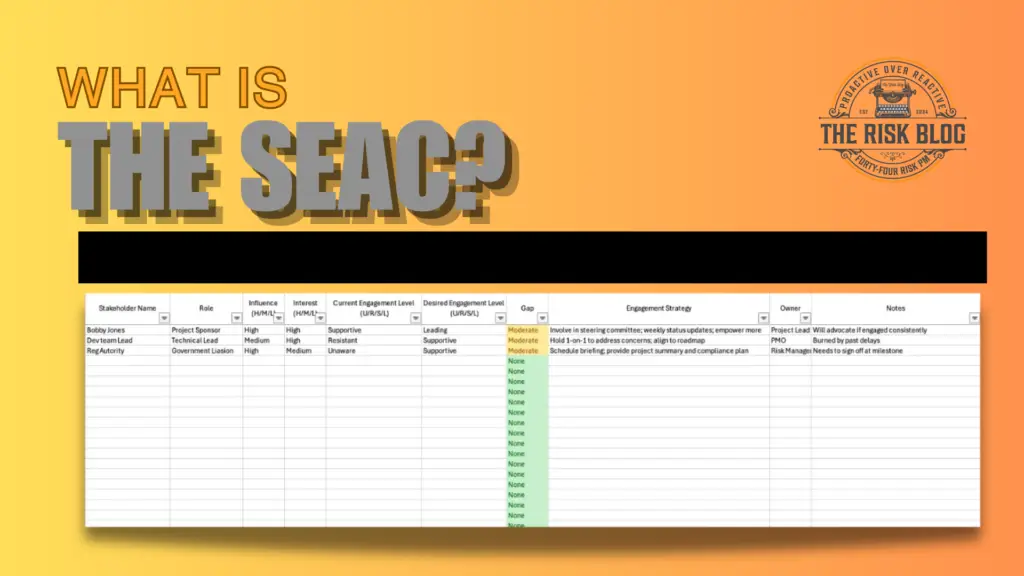
Sound familiar? Well, where is your Stakeholder Engagement Assessment Chart (SEAC)?
Download a formatted SEAC for your projects: (Click the Image)
Last year, I watched a seasoned project manager nearly lose her mind over exactly this scenario.
Sarah had everything under control; except her people.
A department head who seemed “fine” with the project kept finding reasons to delay decisions. A vocal supporter from the early days had gone mysteriously quiet. And don’t get me started on the VP who claimed to back the project but somehow never had time for crucial approvals.
The problem wasn’t Sarah’s project management skills. It was that she was flying blind when it came to the most critical element of any project: the humans involved.
That’s when she discovered something that completely changed how she approached stakeholder management—and it can transform your projects too.
Meet Your New Secret Weapon: The Stakeholder Engagement Assessment Matrix
The Stakeholder Engagement Assessment Matrix (or SEAM, as some of us call it) isn’t just another PM tool to clutter your toolkit. It’s a reality check that shows you exactly where you stand with the people who can make or break your project.
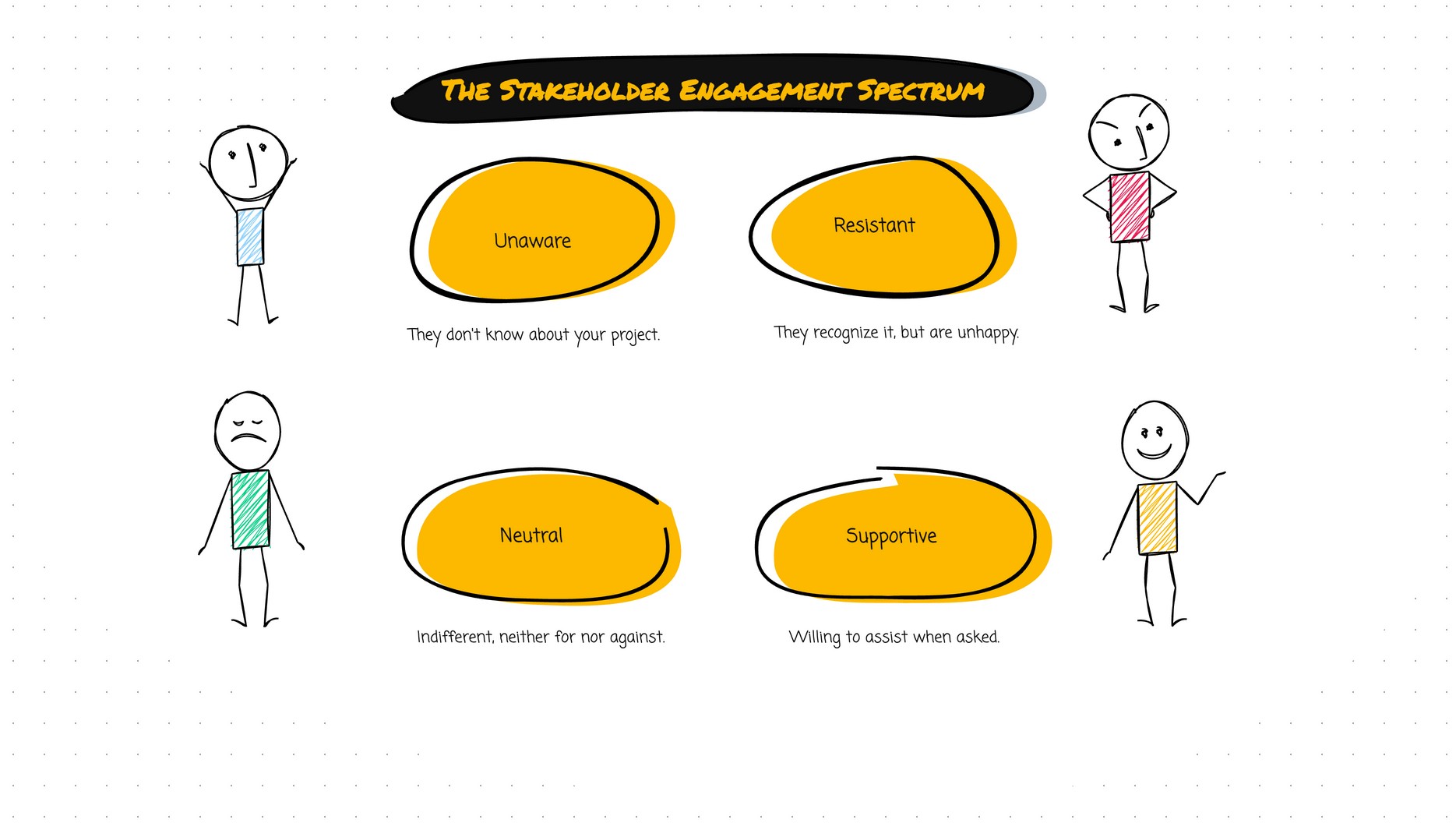
Here’s how it works: Instead of guessing whether someone supports your project, you map out exactly where each stakeholder sits on the engagement spectrum:
- Unaware – They honestly don’t know your project exists (it happens more than you’d think)
- Resistant – They know about it and they’re not happy
- Neutral – They’re Switzerland—not helping, not hurting
- Supportive – They’ll help when asked
- Leading – They’re your champions, actively promoting the project
But here’s where SEAM gets powerful: You don’t just map where people are today. You map where you need them to be for your project to succeed.
Why This Matters More Than You Think
I’ve seen project managers obsess over every dependency in Microsoft Project while completely missing that their biggest blocker is sitting three floors up, quietly unconvinced that the project is worth the disruption.
The hard truth? Projects don’t fail because of bad schedules. They fail because people aren’t aligned.
Think about your last derailed project. I bet if you dig deep, the real problem wasn’t technical—it was human. Someone who should have been supportive turned resistant. A key decision-maker went radio silent. Or worse, everyone said they supported the project while passively undermining it behind closed doors.
SEAM forces you to confront these realities before they become project-killing surprises.
The Transformation I Witnessed
Remember Sarah? Here’s what happened when she finally mapped out her stakeholders using SEAM.
That department head who seemed “neutral”? She realized he wasn’t neutral at all—he was resistant but too polite to say so directly. His delays weren’t about being busy; they were about hoping the project would quietly go away.
Once Sarah saw this clearly, she completely changed her approach. Instead of sending him more emails about deadlines, she scheduled a coffee chat. She listened to his concerns (turned out he was worried the new system would make his team look incompetent). She showed him how the project would actually make his department look like heroes.
Three weeks later, he had moved from secretly resistant to openly supportive. More importantly, his entire department followed his lead.
The project that had been stalled for months suddenly accelerated. Sarah finished two weeks ahead of schedule.
How to Build Your Own Stakeholder Reality Check
Creating your first SEAM doesn’t require a PhD in organizational psychology. Here’s how to get started:
- Start with the obvious players. List anyone who can meaningfully impact your project’s success—sponsors, end users, department heads, IT support, even that administrative assistant who controls the meeting calendar.
- Get real about where they stand today. This is where most people lie to themselves. Don’t rate someone as “supportive” just because they haven’t actively opposed you. If they’re not actively helping, they’re probably neutral at best.
- Be honest about where you need them. You don’t need everyone to be a champion, but you better know who needs to be where. That regulatory compliance person? They probably just need to be neutral. Your executive sponsor? They better be leading.
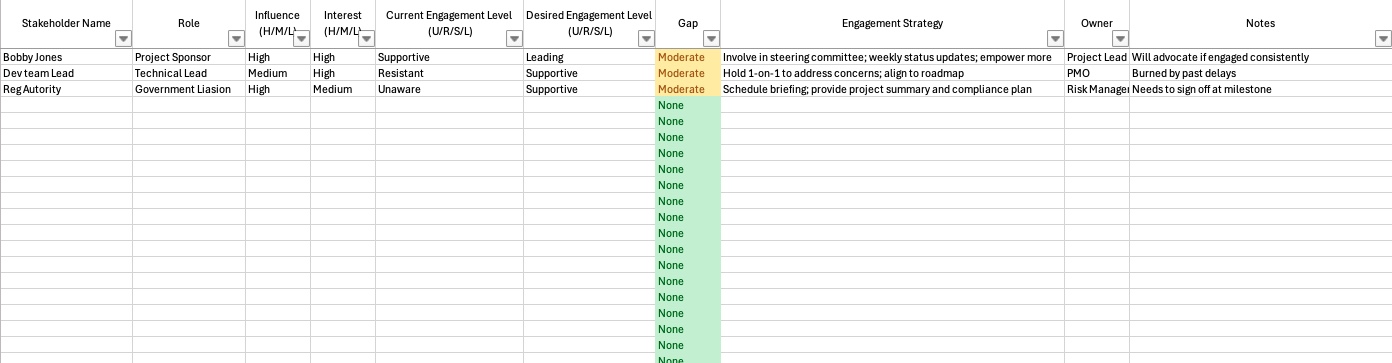
- Map the gap. This is where the magic happens. When you can see that gap between current and desired engagement, you can actually do something about it.
- Create your influence strategy. For each person with a gap, ask yourself: What do they care about? What are their concerns? How can you address those concerns while advancing your project?
The Small Details That Make a Huge Difference
Color-code your chart. Red for big gaps that need immediate attention, yellow for moderate concerns, green for people who are where you need them. Your brain processes visual patterns faster than lists of names.
Update it monthly, not quarterly. Stakeholder sentiment can shift fast, especially during times of organizational change.
Share it strategically. Your sponsor should see a simplified version during regular check-ins. It shows you’re thinking strategically, not just tactically.
Focus your energy where it matters most. Don’t try to turn every neutral stakeholder into a champion. That’s exhausting and unnecessary. Instead, identify the critical few whose engagement levels will make or break your project.
The Real ROI of Getting This Right
When you start managing stakeholder engagement as deliberately as you manage your schedule and budget, something amazing happens: Projects start feeling easier.
Decisions get made faster because the right people are genuinely bought in. Change requests decrease because stakeholders understand and support the direction. Team morale improves because they’re not constantly fighting upstream battles.
Most importantly, you stop feeling like you’re pushing a boulder uphill and start feeling like you’re surfing a wave of momentum.
Your Next Step
Take fifteen minutes right now and list your current project’s key stakeholders. Next to each name, honestly assess where they stand today and where you need them to be.
I guarantee you’ll have at least one “aha” moment—probably several.
The projects that look impossible often aren’t. They just need the right people genuinely aligned behind them. SEAC gives you the clarity to make that happen.
Download our SEAC:
The Risk Blog is a subset of 44Risk PM, LLC