If you’ve ever sat in a project kickoff meeting and thought, “We’re missing something here…”—you’re probably right.
That something is often risk. And even when teams try to uncover it, they often rely on a single method like brainstorming and hope for the best.
The truth is: risk identification is as efficient as the techniques you use.
This guide breaks down 7 proven, techniques to identify project risks effectively. These tools are aligned with the PMBOK® Guide and the PMI-RMP® Exam Content Outline. So, whether you’re studying for a new PMP® or PMI-RMP® certification or leading high-stakes initiatives, this article will sharpen your strategic edge.
Why Risk Identification Techniques Matter
We do not have crystal ball’s for our projects. We cannot see into the future and what problems we might have.
We don’t all have a Dr. Strange ready to assess all the options for our projects to give us the best scenario for delivering on time, on budget, and with all the business value!
So, instead, we use risk management. The process in identifying the good, bad, and ugly that could happen to our project. Then putting these into a logical and well thought out document to assess impacts and how we will treat them throughout the project.
Risk management is about being proactive in finding solutions to problems we don’t know if we will ever actually have.
And the big why behind this is to protect the time, money, and value of our projects.
Risk management helps protect our projects. It is not a simple process though. It takes time. It takes resources. But when it’s done right, the return on investment pays dividends when our project hits roadblocks, but we are ready to react in the right way.
Only Using One Technique?
Now, most PMs I talk to know risk identification is critical—but they don’t always apply it effectively.
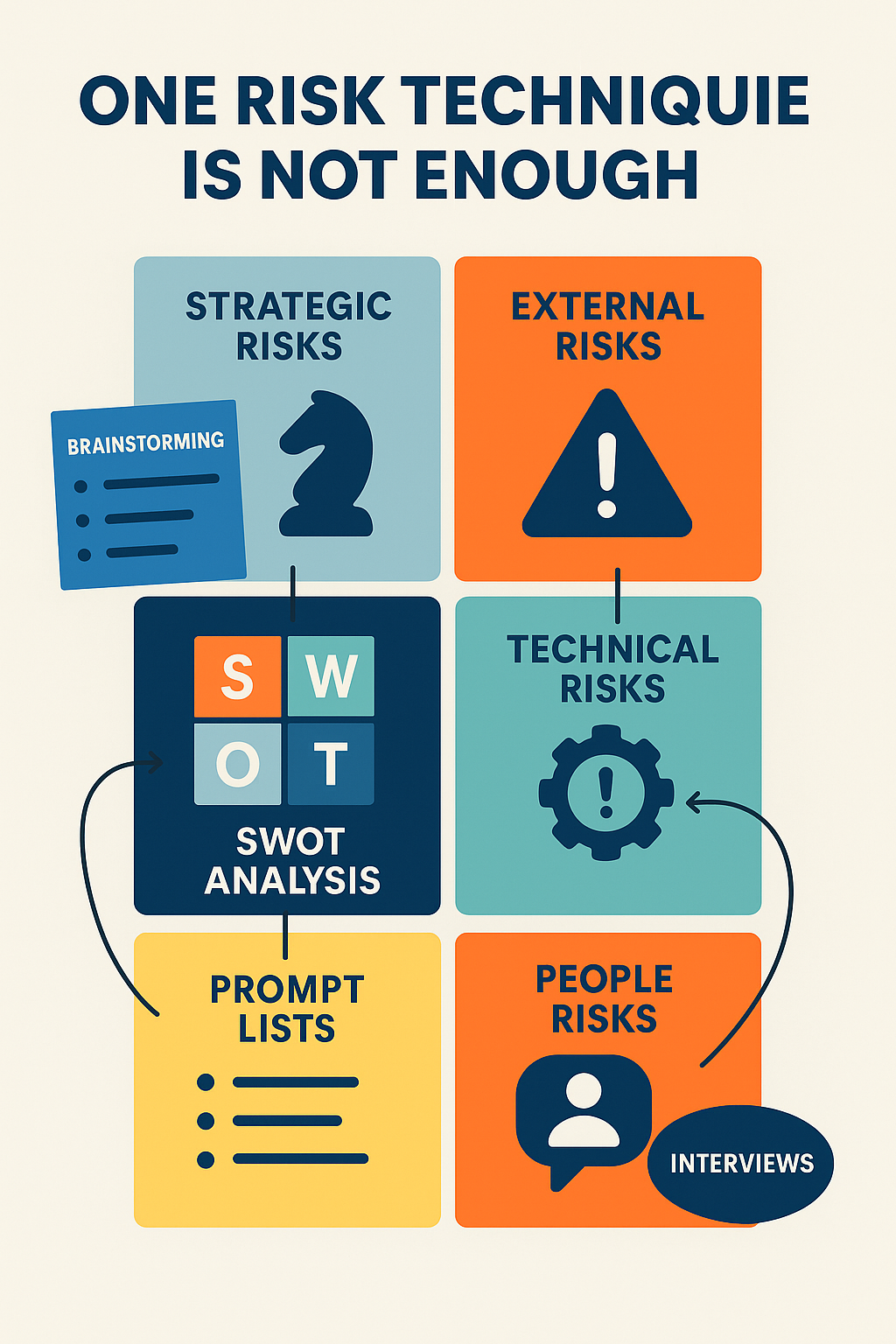
The mistake? Relying on one familiar method. It’s human nature to fall back on what we know. But no single technique will surface every kind of risk. Some require expert input. Some uncover strategic threats. Others are better for team collaboration.
A strong risk identification approach uses multiple methods—structured, strategic, and suited to the project context.
What Are Risk Identification Techniques?
These are tools to surface and document potential uncertainties—good or bad—that could impact your project’s objectives.
It is recommended to use more than one technique because:
- Some are qualitative, others structured
- Some work better for agile teams, others for complex governance
- No one method fits all risk types
The Techniques
1. Brainstorming
What it is: A group session where participants share risk ideas in an open, non-judgmental format.
Best used when: Starting a project, a risk workshop, or at major planning checkpoints.
How to run it well:
- Use sticky notes or digital boards for fast capture
- Establish ground rules (no criticism during idea generation)
- Group risks by theme or category after the session
Watch out for: Groupthink or dominant voices. Consider a neutral facilitator.
2. Delphi Technique
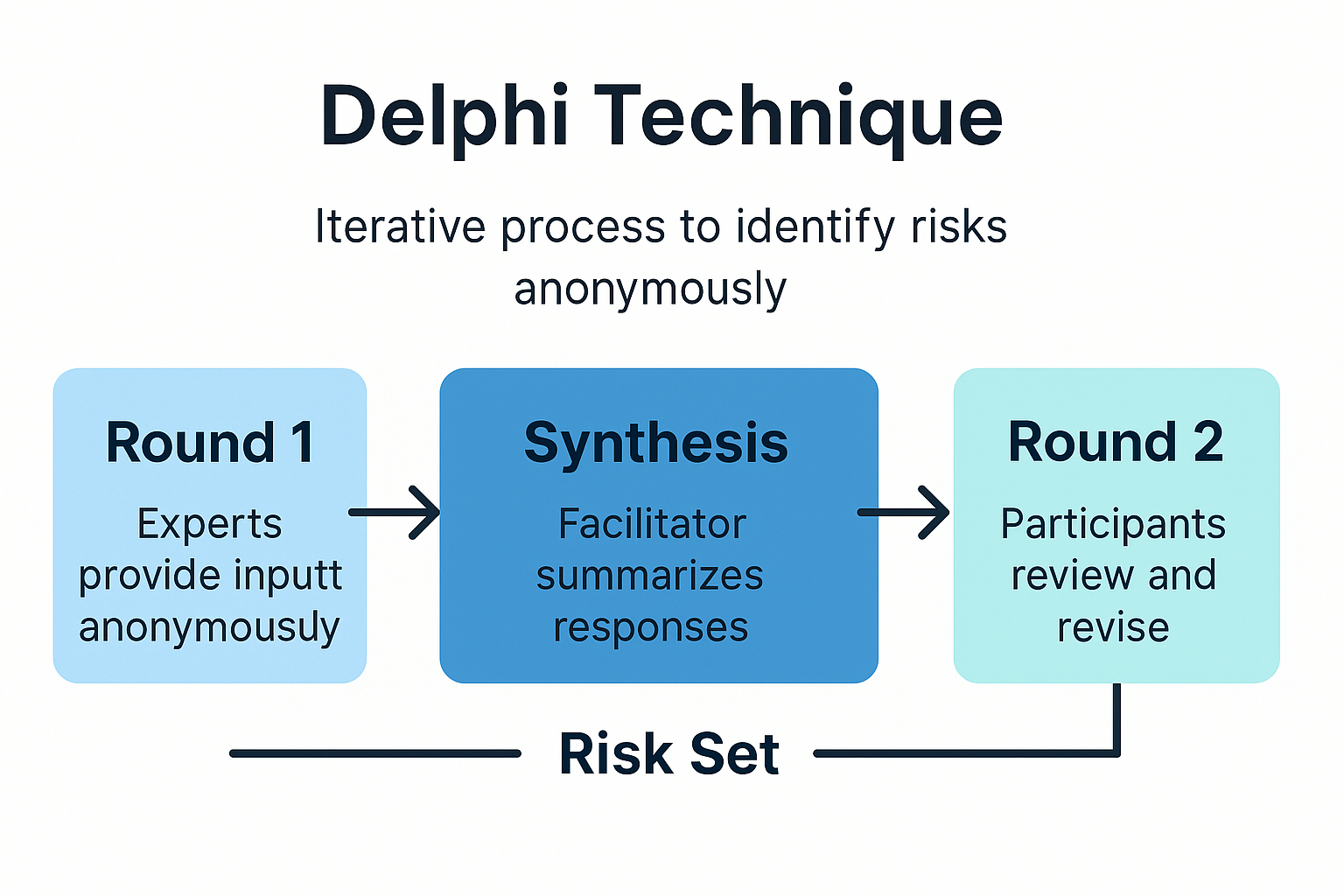
What it is: A structured method that gathers anonymous input from multiple experts across several rounds.
Ideal for: High-complexity or politically sensitive projects.
How it works:
- Experts submit inputs independently
- Facilitator summarizes responses
- Participants review and revise in second (or third) round
Why it’s powerful: Removes bias and surfaces risks others might be afraid to say aloud.
3. Checklists
What it is: A curated list of known risks from similar projects or organizational knowledge bases.
Use when: Working on familiar project types or within mature PMOs.
Checklist tips:
- Include categories (technical, external, legal, etc.)
- Review lessons learned from prior projects
- Always add project-specific risks—not just what’s on the list
Downside: Doesn’t engage innovation or new ideas, instead captures unknown or emergent risks.
4. SWOT Analysis
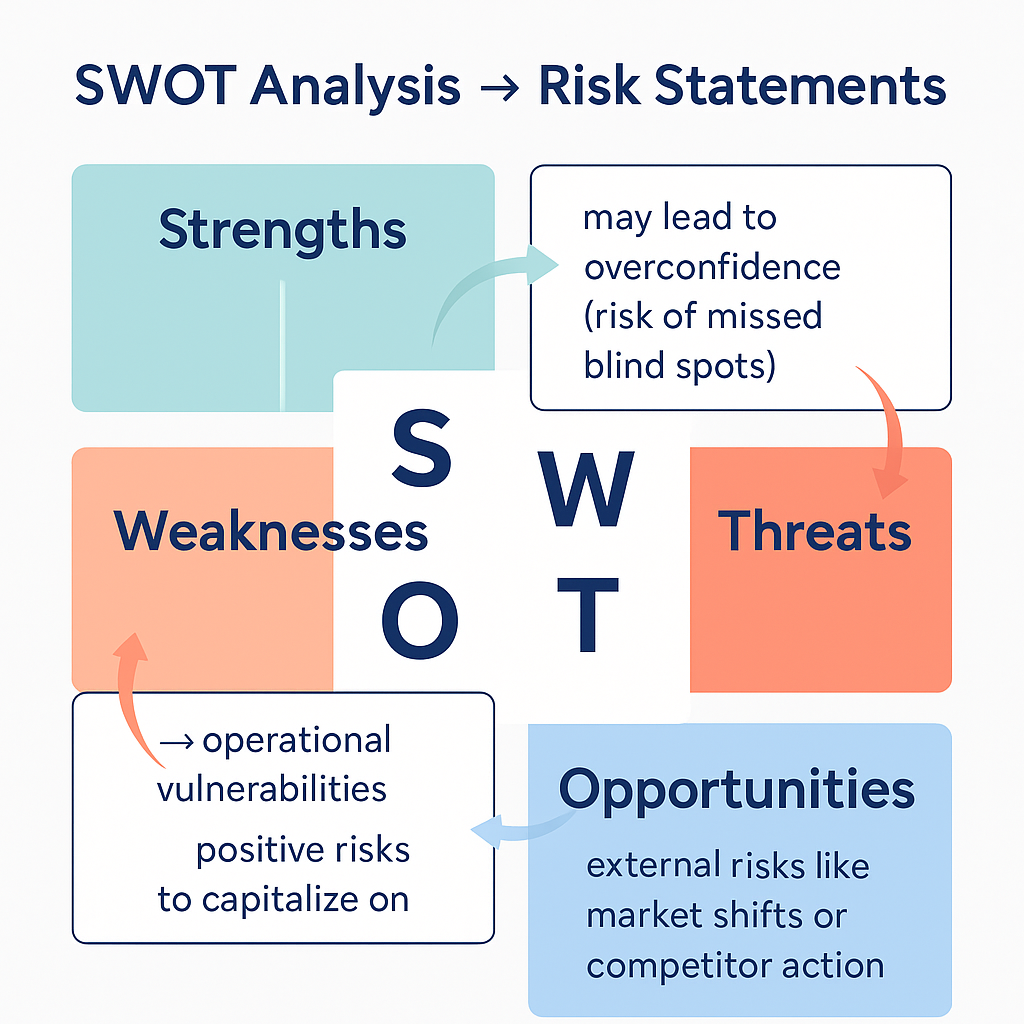
What it is: A strategic technique that maps Strengths, Weaknesses, Opportunities, and Threats.
Use for: High-level project or business case risk scanning.
How to translate SWOT into risk:
- Strengths → may lead to overconfidence (risk of missed blind spots)
- Weaknesses → operational vulnerabilities
- Opportunities → positive risks to capitalize on
- Threats → external risks like market shifts or competitor action
5. Prompt Lists (e.g., PESTLE, TECOP)
What it is: Frameworks that prompt teams to think across domains like political, technical, or commercial risks.
Most common lists:
- PESTLE: Political, Economic, Social, Technological, Legal, Environmental
- TECOP: Technical, Environmental, Commercial, Operational, Political
Why use them: They help reduce blind spots by forcing consideration of categories often missed.
Use them in: Risk workshops, strategic planning, or pre-launch reviews.
6. Interviews
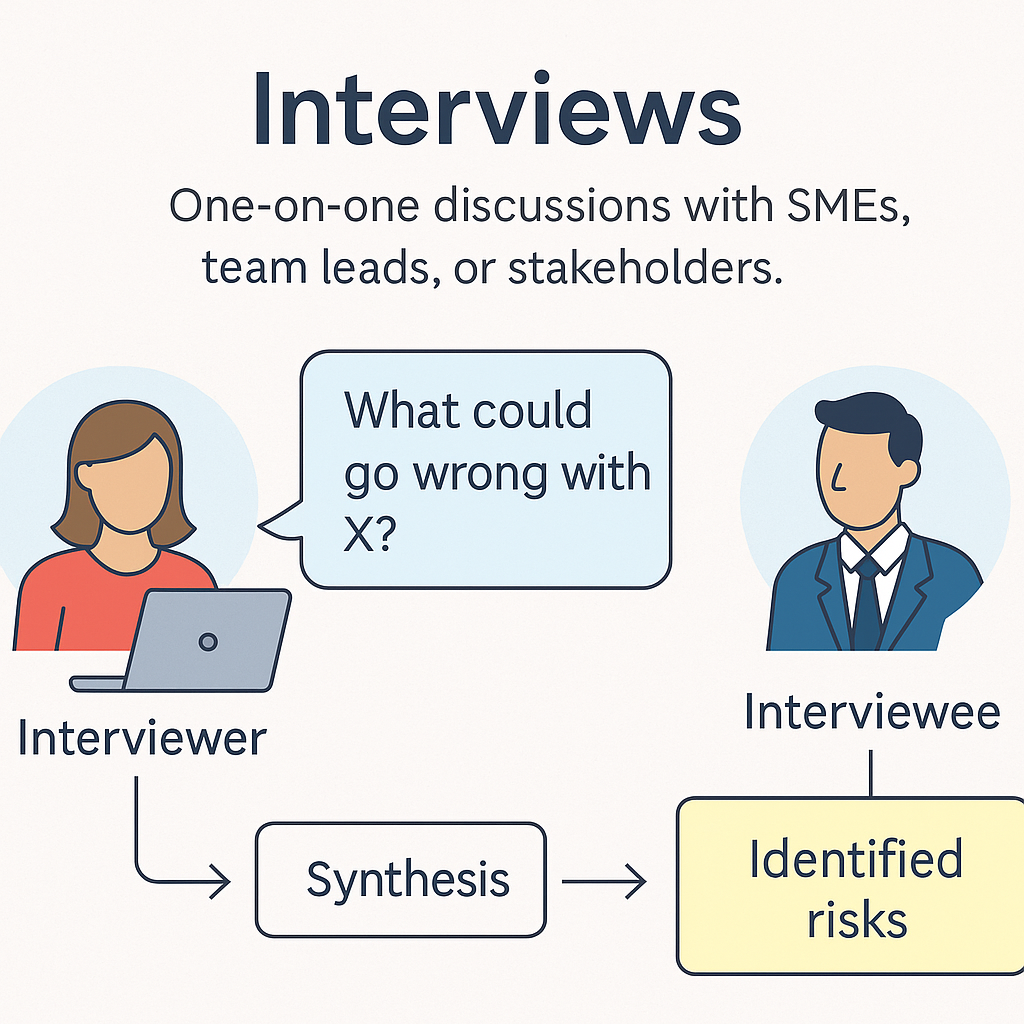
What it is: One-on-one or small-group conversations with SMEs, team leads, or stakeholders.
Use when: The project is complex, technical, or involves sensitive stakeholders.
Tips:
- Ask open-ended questions (e.g., “What could go wrong with X?”)
- Record interviews or summarize key risk triggers
- Validate risks raised by multiple sources
7. Assumption Analysis
What it is: Evaluating whether any assumptions (about schedule, budget, resources, etc.) could fail—and what that failure could cause.
Why it’s crucial: Many risks stem from assumptions that were never challenged.
How to run one:
- List all major assumptions
- Test their likelihood and consequence
- Convert weak or risky assumptions into formal risk entries
Example:
Assumption: “Regulatory approval will come in 2 weeks.”
→ Risk: “If approval takes longer, the go-live date may be delayed by 4 weeks.”
Heading Missing
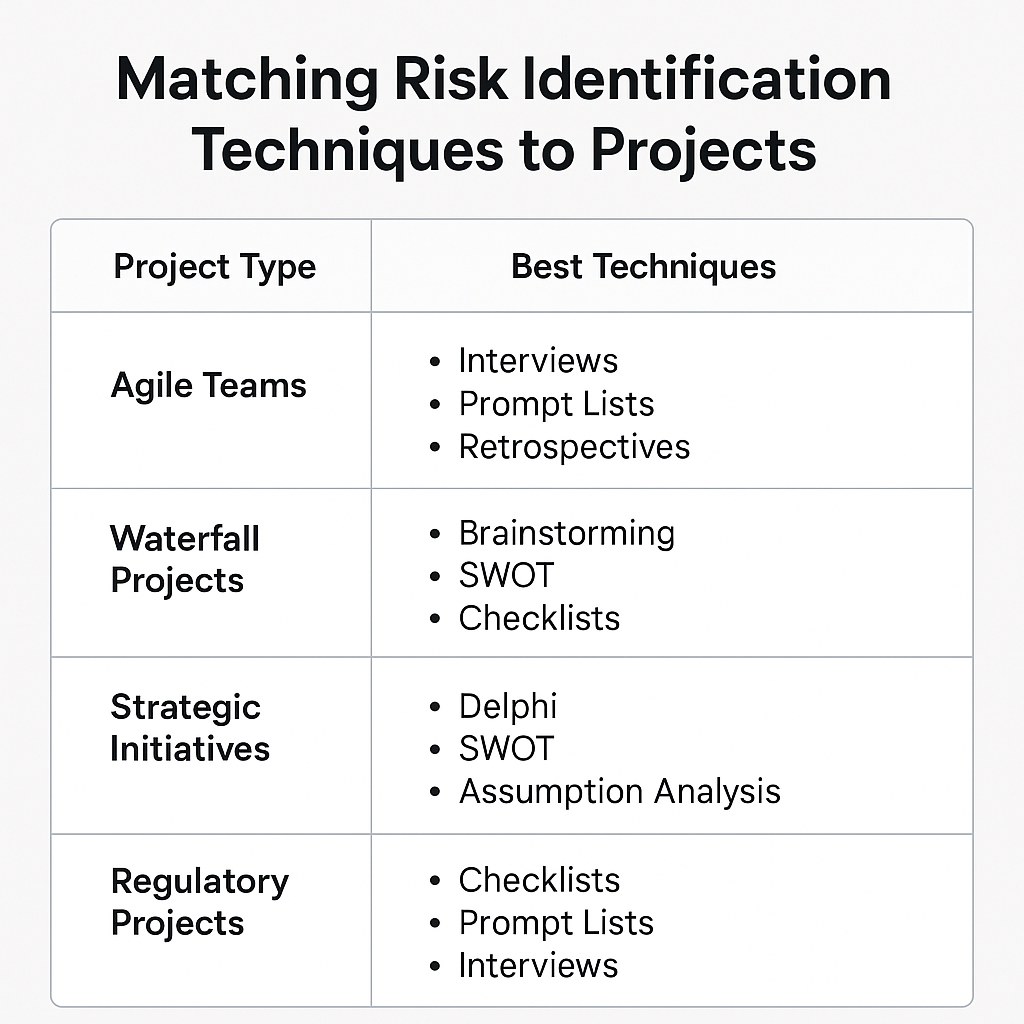
Different projects call for different combinations:
Project Type | Best Techniques |
Agile Teams | Interviews, Prompt Lists, Retrospectives |
Waterfall Projects | Brainstorming, SWOT, Checklists |
Strategic Initiatives | Delphi, SWOT, Assumption Analysis |
Regulatory Projects | Checklists, Prompt Lists, Interviews |
📍 Recommended image: Matrix-style visual matching project types to techniques
When to Use These Techniques
Timing matters just as much as method.
- Project start → Interviews, SWOT, brainstorming
- Planning phase → Prompt lists, checklists, assumption analysis
- Sprint planning (Agile) → Quick interviews, assumption reviews
- After major changes → New brainstorming or assumption validation
- During retrospectives → SWOT and lessons learned inputs
Combine for Coverage
Pair techniques for stronger risk discovery:
- Brainstorming + Checklists = Divergent and structured thinking
- SWOT + Interviews = Internal + external insight
- Delphi + Prompt Lists = Deep expertise + broad coverage
Facilitators can adjust based on phase, risk appetite, and available time.
Call to Action – How to Run These in Real Life
Want to lead high-impact risk sessions using these techniques?
Join our expert-led course: How to Run a Risk Workshop
You’ll learn:
- How to pick and combine the right techniques
- How to structure stakeholder involvement
- What to document, and how to use it during planning and beyond
Final Thoughts: Better Techniques = Smarter Risk Management
Risk management doesn’t start with a spreadsheet—it starts with discovery.
These seven techniques help you uncover risks you would otherwise miss, and they build a risk process that’s trusted, repeatable, and results-driven.
Don’t just list risks. Lead the conversations that surface them.
This post aligns with the PMBOK® Guide, PMI-RMP® Exam Content Outline, and the PMI Practice Standard for Risk Management.

The Risk Blog is a subset of 44Risk PM, LLC and a supporter of 44PM Training Academy.