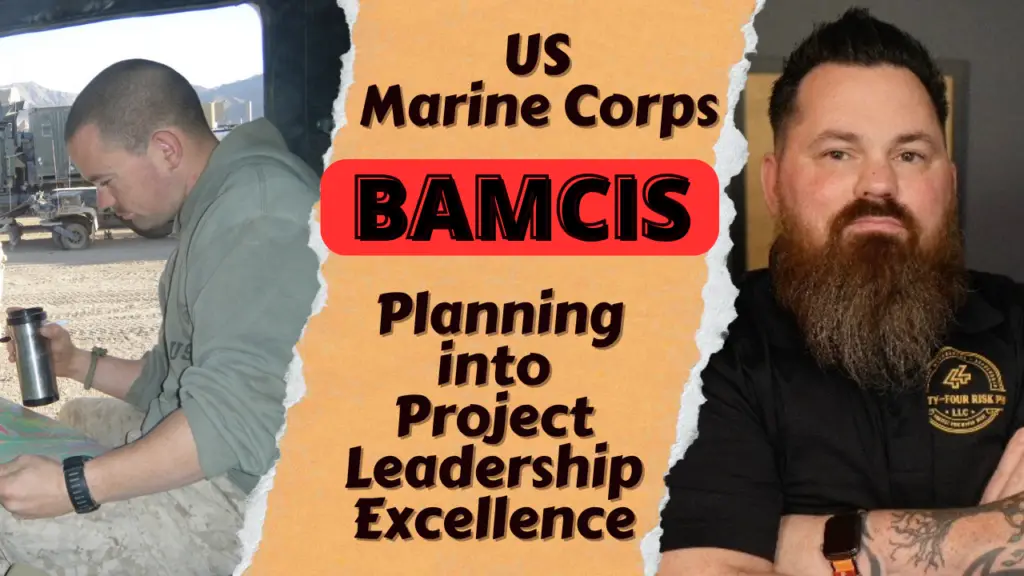

Do you know what the BAMCIS Project Management framework is?
Picture this: You’re 18 years old, standing in the South Carolina heat at Marine Corps Recruit Depot Parris Island. A drill instructor is shouting six letters that will become second nature:
B-A-M-C-I-S.
You have no idea that this simple acronym will shape how you think about planning, leadership, and execution for the rest of your life.
Fast forward twenty years.
You’re leading a critical product launch with tight deadlines, shifting requirements, and stakeholders who seem to change their minds daily. Your Gantt charts are pristine, your status reports are color-coded, but something feels off. You’re managing tasks, not leading a mission.
What if I told you that the same framework drilled into Marine recruits could revolutionize how you approach high-stakes projects?
The Framework That Builds Leaders Under Fire
BAMCIS isn’t just military jargon, it’s a battle-tested planning methodology that transforms how leaders think about preparation, execution, and adaptation. The acronym breaks down into six critical phases:
B – Begin Planning
A – Arrange for Reconnaissance
M – Make Reconnaissance
C – Complete the Plan
I – Issue the Order
S – Supervise
At first glance, this might look like just another planning checklist. But here’s what makes BAMCIS different: it was designed for environments where poor planning doesn’t just mean missed deadlines.
It can mean life or death.
This creates a mindset that every project leader needs: treating planning as a strategic advantage, not administrative overhead.
PURE Project Manager®
See more about the course I teach in the PURE Project Manager® credential and what you can learn from the US Military in becoming a Project Manager.
Why Your Project Needs Military-Grade Planning
The business world has become increasingly volatile.
- Market conditions shift overnight
- Customer expectations evolve rapidly
- And project requirements seem to change faster than you can update your documentation.
Sound familiar? Welcome to the fog of business warfare.
This is exactly why frameworks like my BAMCIS Project Management matter.
While traditional project management focuses on process and documentation, BAMCIS emphasizes situational awareness, rapid adaptation, and leadership presence. It transforms you from a project administrator into a mission commander.
Consider this: PMI’s 2025 Pulse of the Profession report shows that organizations with strategically-minded project leaders are 2.5 times more likely to complete projects successfully. These leaders don’t just follow processes—they think tactically, anticipate problems, and adapt their approach based on real-time intelligence.
Breaking Down BAMCIS Project Management
Let’s walk through how each phase of BAMCIS translates to your next project:
Begin Planning: Setting the Strategic Foundation
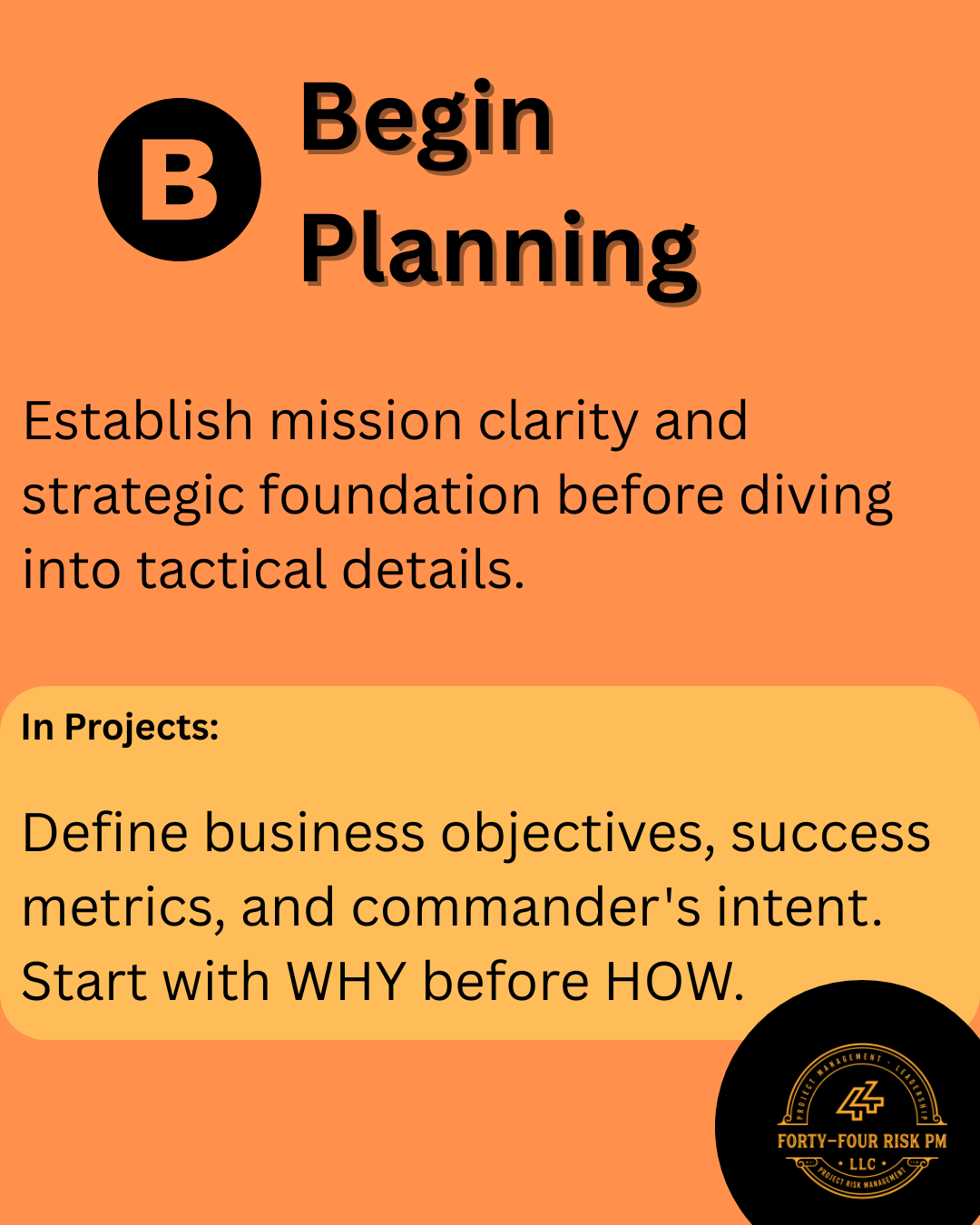
Before Marines touch a map or pick up a radio, they start with the mission.
- What are we trying to accomplish?
- Why does it matter?
- What does success look like?
In project terms, this means starting with clarity on business objectives, not just deliverables. Instead of jumping straight into work breakdown structures, spend time understanding the strategic context.
- What business problem are you solving?
- How will you measure impact?
- What does the organization need from this project to win?
This isn’t the same as writing a project charter (though that’s part of it). This is about developing what Marines call “commander’s intent”—a clear understanding of the mission that guides every subsequent decision.
Arrange for Reconnaissance: Planning Your Intelligence Gathering
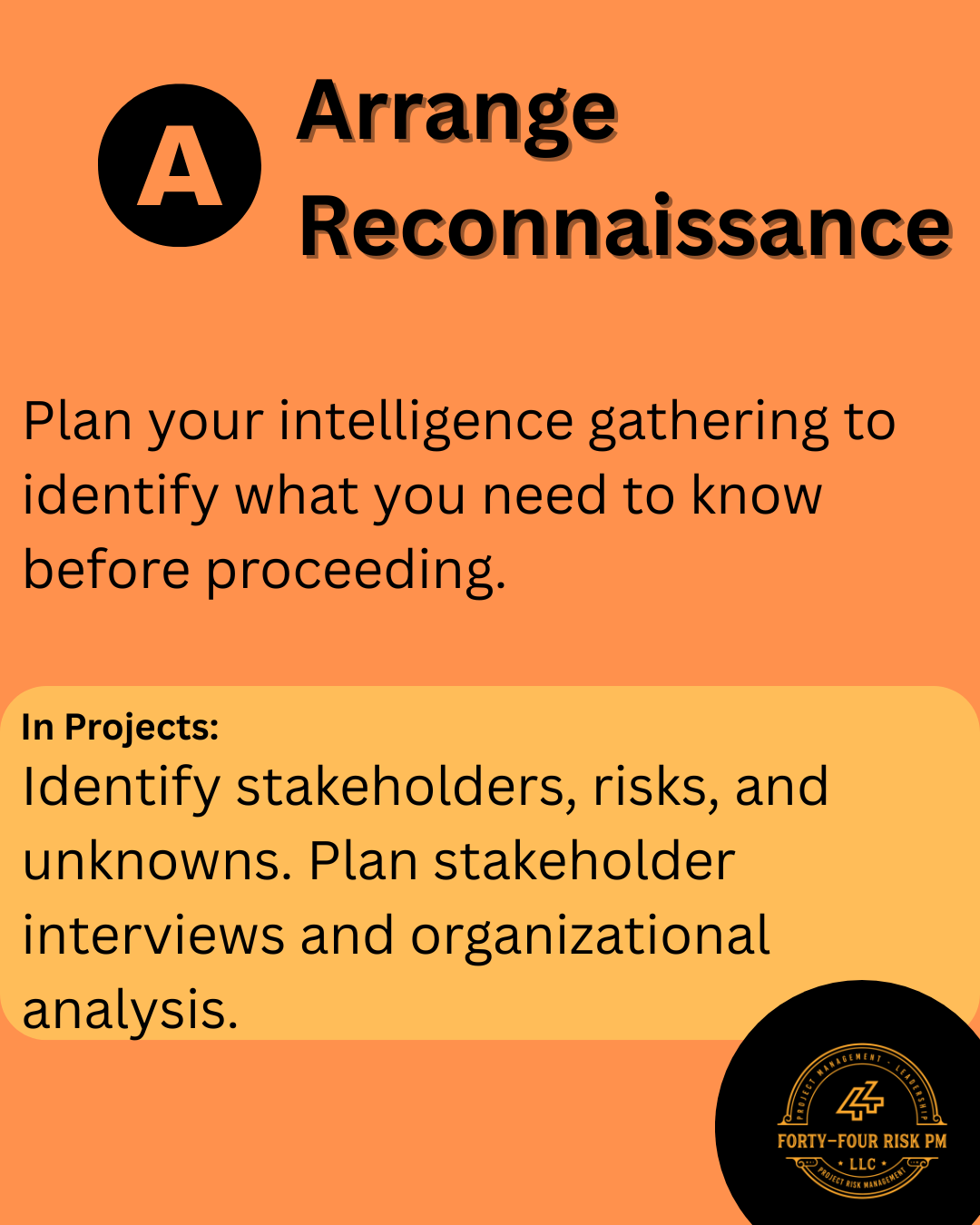
Here’s where BAMCIS Project Management diverges sharply from traditional project management. Before finalizing any plan, you deliberately pause to figure out what you don’t know.
Marines ask:
- What information do I need to make smart decisions?
- Who has that information?
- How will I get it?
- What are the risks if I proceed without it?
For project leaders, this translates to stakeholder intelligence, organizational reconnaissance, and risk discovery.
- Who are the real decision-makers?
- What political undercurrents could derail your project?
- What technical unknowns could blow up your timeline?
- What lessons can you learn from similar projects?
Most project managers skip this step and wonder why they’re blindsided by “unexpected” issues three months later.
Make Reconnaissance: Gathering Real Intelligence
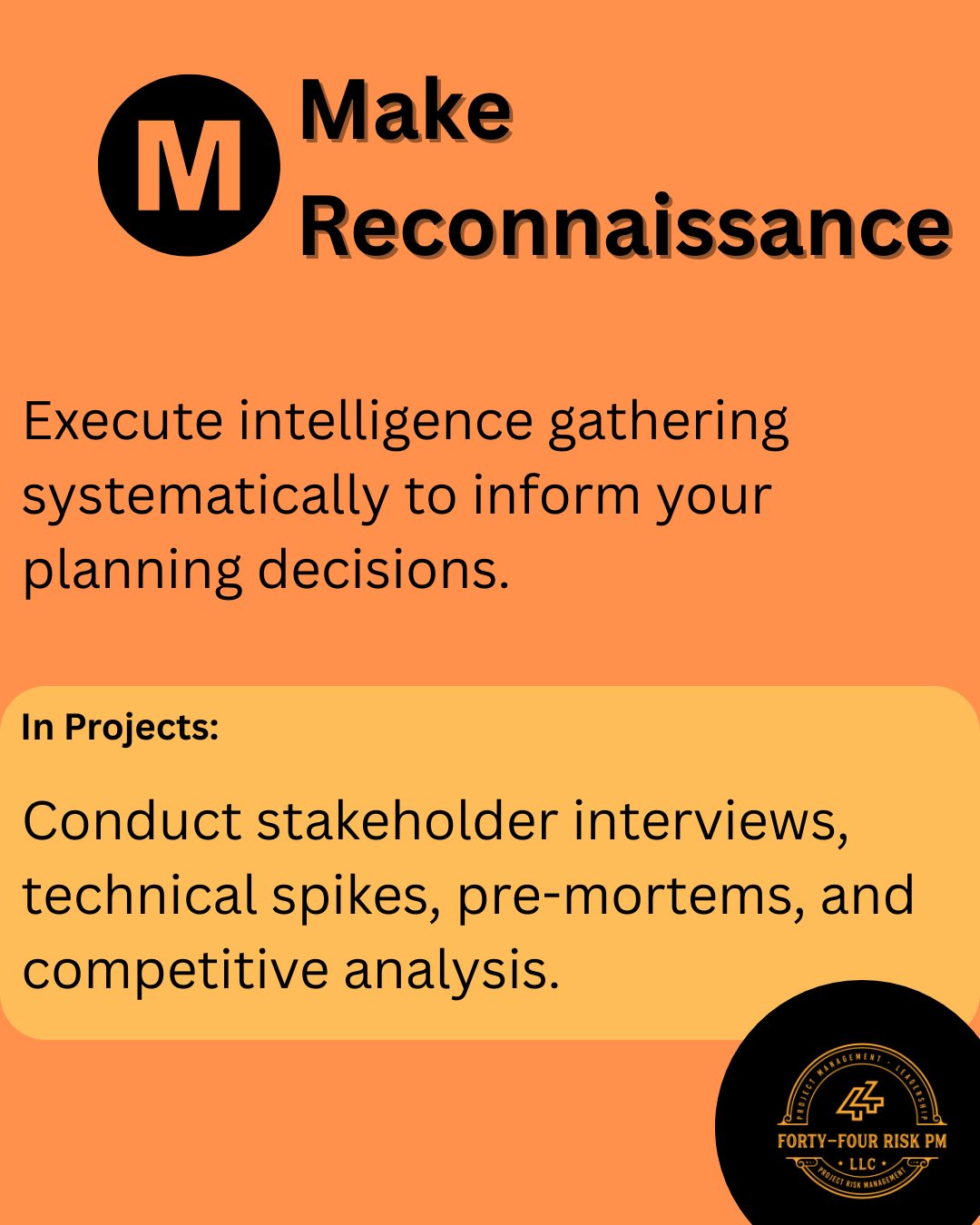
This is where you execute your intelligence-gathering plan.
In the military, this might mean sending out patrols or analyzing satellite imagery. In business, it means stakeholder interviews, technical spikes, organizational analysis, and competitive research.
The key is being systematic and purposeful. You’re not gathering information for the sake of it—you’re collecting specific intelligence that will inform your planning decisions.
- What are the stakeholder’s real priorities (not just what they say in meetings)?
- Where are the technical landmines?
- What resource constraints aren’t obvious from the org chart?
Smart project leaders also run “pre-mortems” during this phase—imagining the project has failed and working backward to identify potential failure modes. This isn’t pessimism; it’s tactical thinking.
Complete the Plan: Building Your Battle Plan
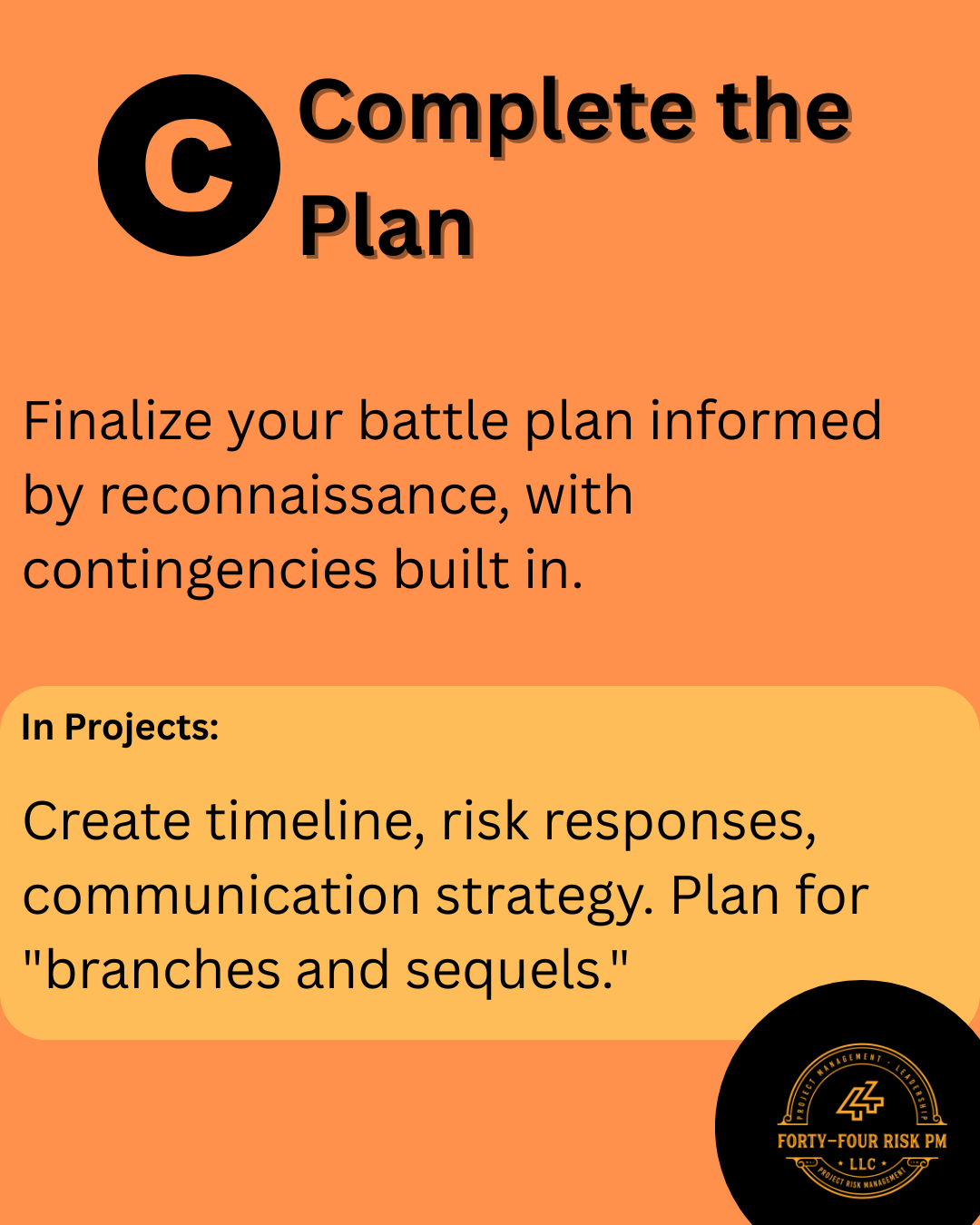
Only now do you finalize your project plan—but it’s informed by all the reconnaissance you’ve conducted. Your timeline accounts for the political realities you’ve uncovered.
Your risk register includes the organizational dynamics you’ve mapped. Your communication strategy reflects the stakeholder intelligence you’ve gathered.
This isn’t about creating the perfect plan (no plan survives first contact with reality). It’s about creating a robust plan that can adapt as conditions change. Marines call this “planning for branches and sequels”—having contingency options ready when the original plan needs adjustment.
Issue the Order: Leading the Mission Launch
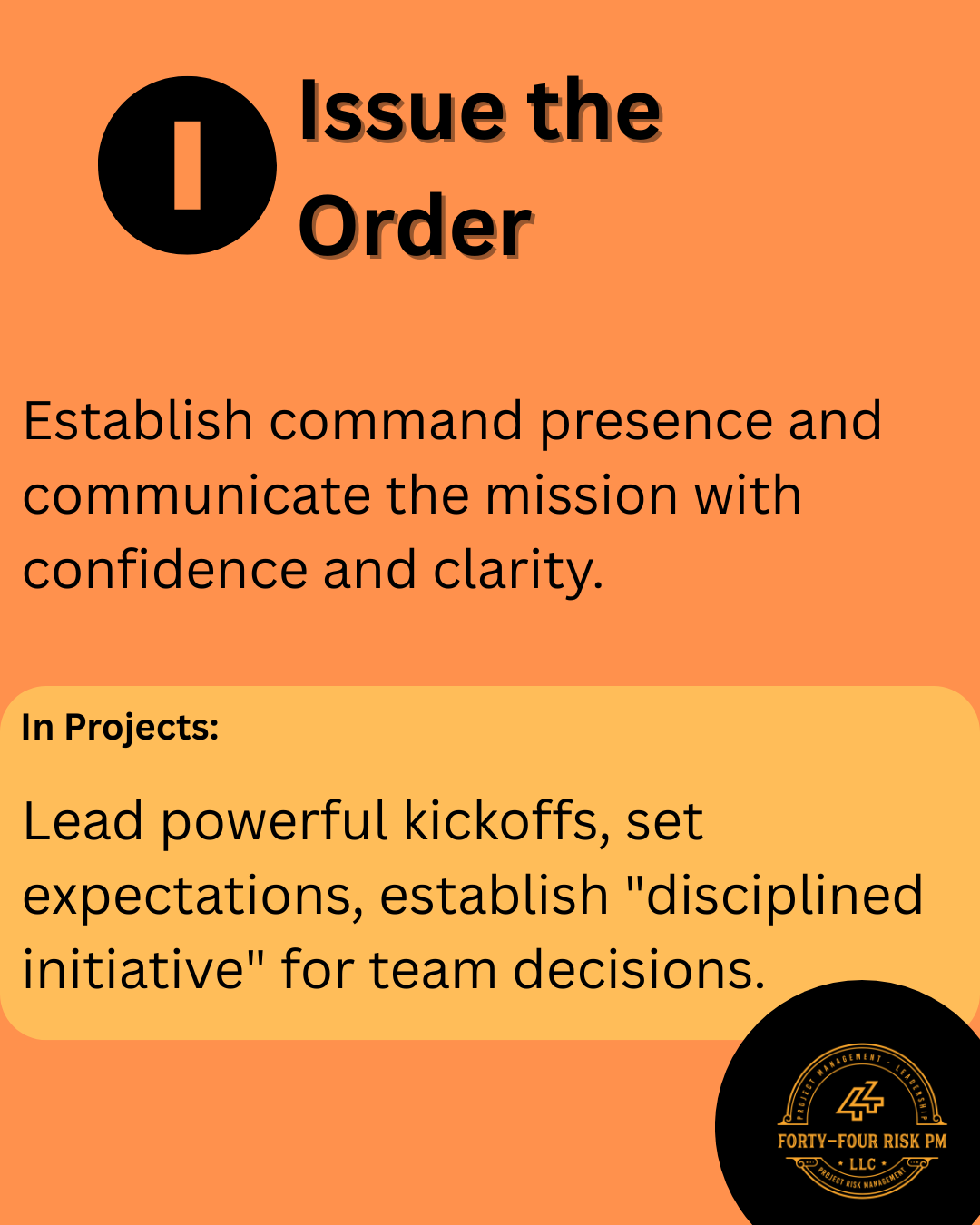
This is more than a kickoff meeting—it’s about establishing command presence and setting the operational tone for your project. You’re not just sharing information; you’re inspiring confidence, clarifying expectations, and demonstrating that you’ve thought through the challenges ahead.
Great project leaders use this moment to establish what Marines call “disciplined initiative”—empowering team members to make decisions within clear boundaries. They communicate not just what needs to be done, but why it matters and how each person contributes to mission success.
Supervise: Maintaining Tactical Control
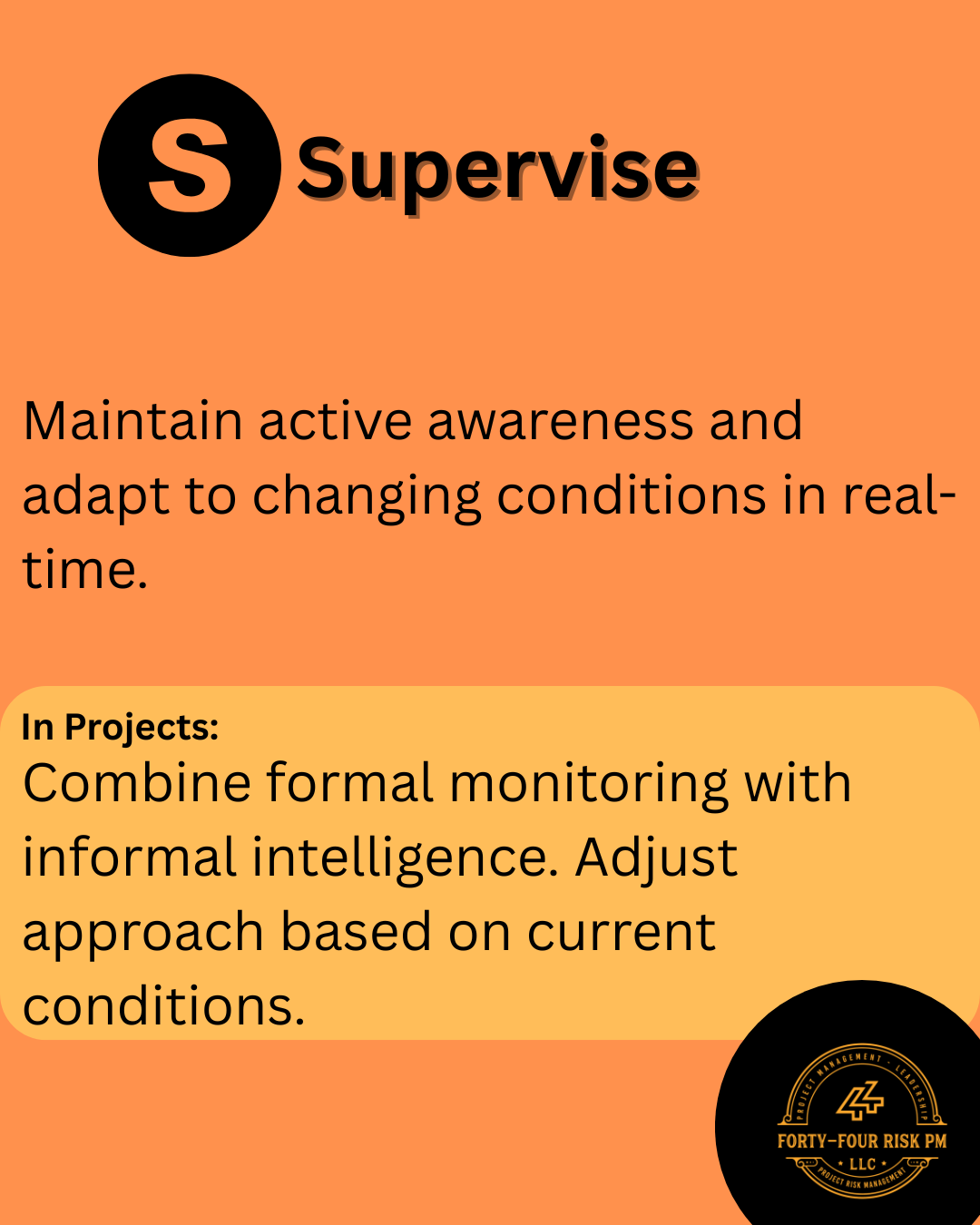
The “S” is the most important letter in BAMCIS. This is also where many project managers can fall short.
They think supervision means status meetings and dashboard updates. In BAMCIS, supervision means maintaining active awareness of changing conditions and adjusting your approach accordingly.
Marines supervise by being present, asking probing questions, and making real-time adjustments. They don’t wait for weekly status reports to learn about problems—they’re constantly taking the pulse of their unit and the battlefield.
For project leaders, this means combining formal monitoring (your dashboards and reports) with informal intelligence gathering (hallway conversations, team dynamics, early warning signals).
You’re not just tracking progress against the plan; you’re assessing whether the plan still makes sense given current conditions.
The Evolution of Leadership Thinking
Here’s what’s fascinating about the Marine Corps approach:
BAMCIS Project Management is just the beginning.
As Marines advance in rank and responsibility, they graduate to more sophisticated planning frameworks like OSMEAC (Orientation, Situation, Mission, Execution, Administration/Logistics, Command/Signal) and eventually the full Marine Corps Planning Process (MCPP).
This mirrors the journey of project professionals.
You start with task management, evolve into risk-aware planning, then develop into strategic business advisors who can operate at the enterprise level. Maybe even starting with the CAPM credential before stepping into the PMP.
Each stage builds on the previous one, but the foundational thinking patterns established early make all the difference.
Why This Matters Now
The project management profession is undergoing a fundamental shift.
PMI’s research shows that organizations increasingly value project leaders who can think strategically, communicate across functions, and drive business outcomes—not just manage schedules and budgets.
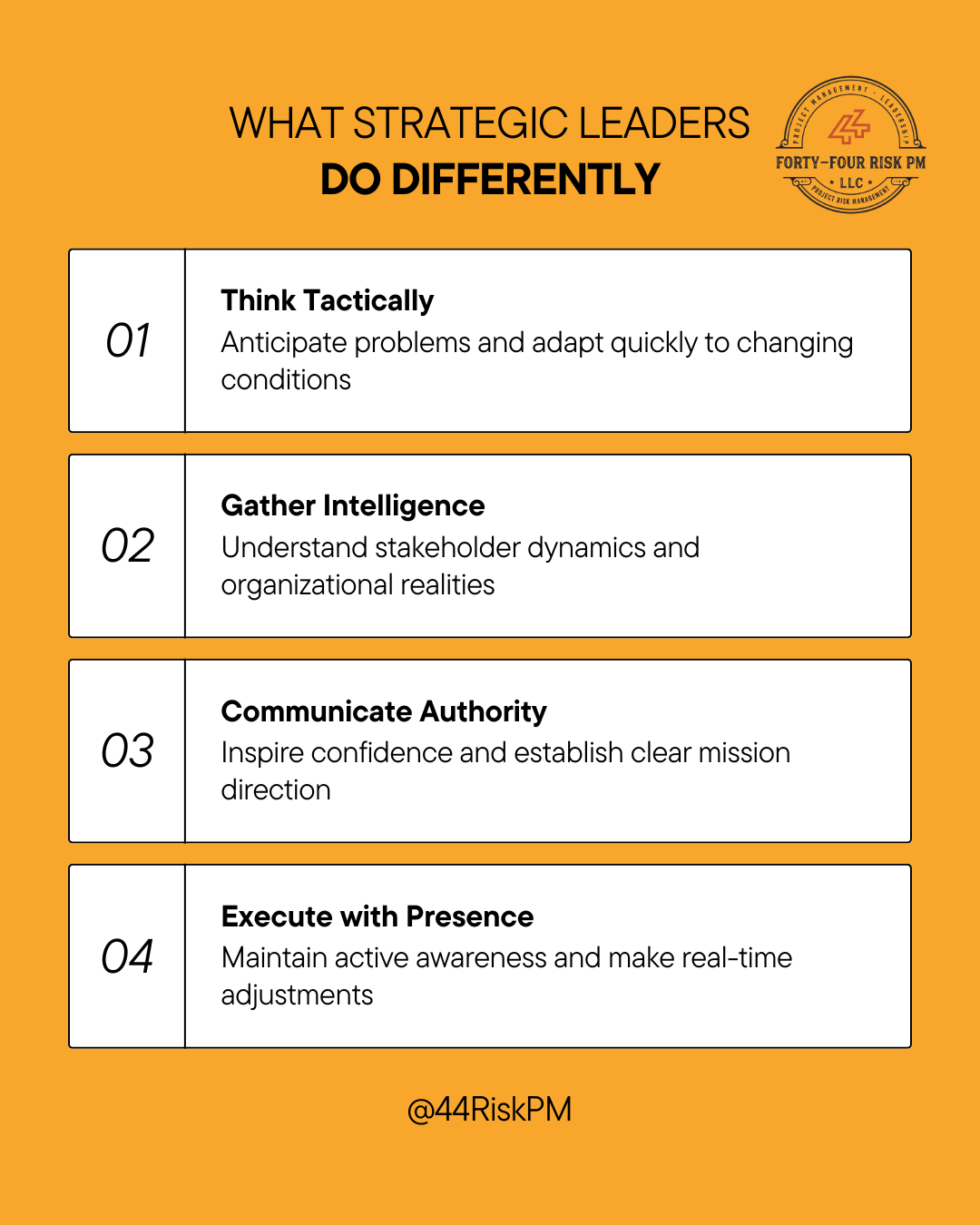
This is exactly what military planning frameworks like BAMCIS Project Management develop: leaders who can think tactically under pressure, gather and synthesize complex information, communicate with authority, and adapt quickly to changing conditions.
In an era where “agile” has become synonymous with “figuring it out as we go,” BAMCIS offers something different: disciplined flexibility. It’s structured enough to ensure thorough preparation, but flexible enough to adapt when reality doesn’t match your assumptions.
Making It Real: Your Next Mission
Ready to apply this thinking to your current project?
Start small. Pick one element of BAMCIS and deliberately incorporate it into your next planning cycle.
Maybe it’s spending more time on reconnaissance—really understanding the stakeholder landscape before finalizing your approach. Maybe it’s improving how you “issue the order”—turning your next kickoff into a moment that builds confidence and clarity rather than just sharing information.
Or maybe it’s upgrading your supervision approach—combining formal tracking with active leadership presence.
The goal isn’t to militarize your workplace (please don’t start calling meetings “briefings” or refer to your team as “Marines”). The goal is to adopt the mental models that create confident, adaptive leaders who can execute under pressure.
The Missing Link in Project Leadership
Most project management training focuses on tools, templates, and processes. That’s important, but it’s not enough. The real differentiator is developing the leadership mindset that allows you to use those tools effectively under real-world conditions.
One way to understand how to grow is to have solid Leadership Traits and Principles that you follow throughout your career. You can see my full article on this topic at: “Leadership Principles and Traits: A PM’s Guide to Leading Like a US Marine.”
BAMCIS offers that missing link. It’s not another methodology to layer on top of Agile or Waterfall—it’s a way of thinking about planning and leadership that makes any methodology more effective.
In a world where every project feels like a mission-critical operation, maybe it’s time to start planning like one.
The Risk Blog is a subset of 44Risk PM, LLC