RMP Prep

PMI-RMP Eligibility Requirements

PMI-RMP Eligibility Requirements Article Thumbnail
Complete guide to PMI-RMP eligibility requirements: education, experience & contact hours. Learn if you qualify for the Risk Management Professional exam.

Complete 2025 Guide to Understanding the PMI-RMP Eligibility Requirements

You’re ready to pursue the PMI Risk Management Professional (PMI-RMP) certification. You’ve researched the value proposition, assessed the career benefits, and committed to the preparation journey.

But before you purchase study materials, block calendar time for exam prep, or invest hundreds of dollars in application and exam fees, there’s one critical question you must answer:
 
Do you actually meet the PMI-RMP Eligibility Requirements?? 
Every year, thousands of capable risk professionals experience costly delays—or outright rejection—because they misunderstood the PMI-RMP eligibility requirements.
 
Some apply prematurely.
 
Others misrepresent their experience unintentionally.
 
Many simply don’t realize their project management work doesn’t qualify as specialized risk management experience.
 
This comprehensive guide eliminates that uncertainty. You’ll learn exactly what PMI requires in the Exam Content Outline to qualify for the PMI-RMP exam, how to assess your own eligibility, what documentation you need, and how to avoid the common application mistakes that trigger delays and audits.
 
By the end of this guide, you’ll know:
  • Whether you currently meet PMI-RMP eligibility requirements
  • What gaps (if any) you need to close before applying
  • How to document your experience properly
  • What triggers PMI application audits—and how to pass them
  • When to submit your application for optimal timing

What are the PMI-RMP Eligibility Requirements?

The PMI-RMP certification is administered by the Project Management Institute (PMI) and is designed specifically for professionals who specialize in project risk management—not just general project management.
 
To be eligible for the PMI-RMP exam, candidates must meet three core requirements:
  1. Educational qualification (high school diploma through bachelor’s degree or higher)
  2. Specialized risk management experience (12-36 months depending on education)
  3. Formal risk management training (30-40 contact hours depending on education)
These requirements work together to ensure that PMI-RMP credential holders are actively practicing risk management using current methodologies, tools, and governance frameworks.

Why PMI Takes Eligibility Requirements Seriously

Unlike some certifications where eligibility is essentially self-certified, PMI actively enforces its requirements across all certifications through:
  • Application review – Every application undergoes initial screening
  • Random audits – Approximately 10-15% of applications are selected for documentation audit
  • Experience verification – Audited candidates must provide manager signatures and proof
  • Rejection or delay – Applications with unclear, overstated, or misaligned claims are sent back
Understanding eligibility requirements before you apply helps you:
✅ Avoid wasted preparation time studying for an exam you can’t yet take
✅ Prevent application rework that delays your exam by weeks or months
✅ Pass audits smoothly with properly documented experience
✅ Apply with confidence instead of uncertainty and guesswork
 
Think of eligibility verification as the first risk assessment in your PMI-RMP journey. Professionals who manage project risk effectively should certainly be able to assess their own certification eligibility accurately.

Join the 44Risk PM Email List

Get on the list to receive weekly emails from me and notifications on special courses, webinars, and other announcements throughout the year.  

    The Three-Part PMI-RMP Eligibility Framework

    PMI structures eligibility around three interconnected requirements. Your education level determines the specific experience and training thresholds you must meet.
     
    Let’s break down each component in detail.

    1. Educational Requirements: Your PMI-RMP Requirements Eligibility Pathway

    PMI recognizes multiple educational pathways to the PMI-RMP certification. Your highest completed level of education determines which pathway you follow.
     
    PMI-recognized education levels:
    • Secondary education (high school diploma, GED, or global equivalent)
    • Associate’s degree (two-year college degree or global equivalent)
    • Bachelor’s degree (four-year college degree or global equivalent)
    • Graduate degree (master’s, doctorate, or global equivalent)
    • GAC-accredited degree (Global Accreditation Center for Project Management Education Programs)

    How Education Affects Your PMI-RMP Requirements

    Your education level creates a sliding scale for experience and training requirements:


    Education Level


    Risk Experience Required


    Contact Hours Required


    High school diploma or associate’s degree


    36 months (3 years)


    40 hours


    Bachelor’s degree or higher


    24 months (2 years)


    30 hours


    GAC-accredited degree


    12 months (1 year)


    30 hours


    Key insight: PMI reduces experience requirements when candidates have formal education that demonstrates structured exposure to project management and risk management principles.

    What Counts as Valid Education?

    Acceptable documentation:
    • Official transcripts
    • Diploma or degree certificate
    • University verification letter
    Important notes:
    • Education must be completed before you submit your application
    • Degrees in progress don’t qualify until officially conferred
    • International degrees are evaluated for equivalency
    • PMI doesn’t require specific majors—any completed degree qualifies
    What if you’re currently completing a degree? Wait until your degree is officially conferred and you have documentation. Applying prematurely leads to rejection.

    GAC-Accredited Degrees

    If you hold a degree from a Global Accreditation Center (GAC) accredited program, you qualify for reduced requirements:
    • Only 12 months of risk management experience required
    • Only 30 contact hours of training required
    GAC accreditation signals that your degree program specifically incorporated project management education that PMI recognizes as equivalent to professional experience.

    How to verify GAC accreditation: Check PMI’s official list of GAC-accredited programs on PMI.org. If your program isn’t listed, it doesn’t qualify for reduced requirements.
     
    What I like to say is that if don’t know if you are in a GAC-accredited program, then you are not in a GAC-accredited program. These programs are advertised and you’ll know if in one.

    2. Risk Management Experience Requirements (The Most Critical Component)

    Experience is the most scrutinized and most frequently misunderstood part of PMI-RMP eligibility.
    Here’s the critical distinction that trips up most applicants:
     
    PMI requires specialized risk management experience—not general project management activities.

    What Qualifies as Risk Management Experience

    Your experience must demonstrate hands-on involvement in project risk management activities, including:
     
    Risk Strategy and Planning:
    • Developing risk management plans
    • Defining risk appetites and thresholds
    • Establishing risk governance structures
    • Creating escalation pathways
    Risk Identification:
    • Leading or facilitating risk identification workshops
    • Conducting risk interviews and Delphi sessions
    • Analyzing assumptions and constraints
    • Documenting risks in risk registers
    Risk Analysis:
    • Performing qualitative risk analysis (probability and impact assessment)
    • Conducting quantitative risk analysis (EMV, Monte Carlo simulation, decision trees)
    • Prioritizing risks based on exposure
    • Assessing risk data quality
    Risk Response:
    • Developing risk response strategies (avoid, mitigate, transfer, accept, exploit, enhance, share)
    • Assigning risk ownership
    • Planning contingent responses
    • Calculating and justifying contingency reserves
    Risk Monitoring and Control:
    • Tracking identified risks throughout project lifecycle
    • Conducting risk reassessments and audits
    • Reporting risk status to stakeholders
    • Closing risks and capturing lessons learned

    What Does Not Qualify as risk Management Experience?

    Many project managers assume their work qualifies, but these activities alone don’t meet PMI’s specialized risk management standard:

    ❌ General project planning and scheduling
    ❌ Stakeholder management without risk focus
    ❌ Budget tracking and cost control (unless analyzing cost risk)
    ❌ Issue management and problem-solving
    ❌ Quality assurance activities
    ❌ Team leadership and coordination
    ❌ Status reporting without risk analysis
     
    The test: If you remove the word “risk” from your activity description and it still describes standard project management, it probably doesn’t qualify as specialized risk management experience.

    The Give-Year Experience Window: A Strict Requirement

    All qualifying risk management experience must have occurred within the five consecutive years immediately prior to your application submission date.
     
    This rule is strictly enforced.
     
    Examples:
    • ✅ Applying January 2025: Experience from January 2020-January 2025 qualifies
    • ❌ Applying January 2025: Experience from 2015-2018 does NOT qualify
    • ❌ Applying January 2025: Experience from 2018-2019 does NOT qualify (outside five-year window)

    Why PMI Enforces the Five-Year Window

    Risk management standards, methodologies, tools, and expectations evolve continuously. PMI wants credential holders who are:
    • Currently practicing risk management, not relying on decade-old experience
    • Up to date with modern risk analysis techniques and tools
    • Relevant to today’s risk-intensive project environments
    • Active in the profession, not distant from current practice
    Strategic implication: If you’re close to the five-year boundary, apply sooner rather than later. Waiting could disqualify valuable experience.

    The Non-Overlapping Experience Rule

    PMI counts unique months of risk management experience, not total project months.

    Here’s what this means in practice:
    If you worked on multiple projects simultaneously, PMI counts the calendar months once—not multiple times.
     
    Example scenario:
    • Project A: January 2023 – December 2023 (12 months, 50% of your time)
    • Project B: January 2023 – June 2023 (6 months, 30% of your time)
    • Project C: July 2023 – December 2023 (6 months, 20% of your time)
    PMI counts this as: 12 months of experience total (January-December 2023), NOT 24 months
     
    Your application must demonstrate:
    • Total calendar months within five-year window
    • Risk management activities were performed during those months
    • Sufficient depth of involvement to claim professional experience

    How to Calculate Your Qualifying Experience

    Step 1: List all projects where you performed risk management activities in the past five years
    Step 2: Identify the start and end date of your risk management involvement on each project
    Step 3: Combine overlapping periods into unique calendar months
    Step 4: Sum the total unique months
     
    Example calculation:


    Project


    Risk Mgmt Period


    Unique Months


    Alpha System Implementation


    Mar 2022 – Aug 2022


    6


    Beta Infrastructure Upgrade


    Sep 2022 – Feb 2023


    6


    Gamma Digital Transformation


    Jan 2023 – Dec 2024


    24


    Total qualifying experience


    30 months


    Note: January-February 2023 overlaps between Beta and Gamma, so it’s counted once in the Gamma total.

    Part-Time and Fractional Experience

    Does part-time risk management work count?
    Yes—but the calculation is based on calendar months, not hours.
    If you performed risk management activities as 25% of your role for 12 months, PMI counts this as 12 months of experience (assuming the activities meet the specialized risk management standard).
     
    What matters to PMI:
    • Did you perform risk management tasks during this period?
    • Were those tasks substantial enough to constitute professional experience?
    • Can you describe specific risk activities you led or contributed to?
    What doesn’t matter:
    • Whether risk management was 100% or 25% of your job
    • Whether you had “Risk Manager” in your title
    • Whether you worked full-time or part-time

    3. Contact Hours: Risk Management Training Requirements

    In addition to experience, PMI requires formal education specifically in project risk management.

    Understanding Contact Hours

    contact hour equals 60 minutes of structured learning or instruction in risk management topics.
     
    Contact hour requirements by education level:
    • High school diploma or associate’s degree: 40 contact hours
    • Bachelor’s degree or higher: 30 contact hours
    • GAC-accredited degree: 30 contact hours
    This is a different requirement from certifications like the PMP, where its a flat 35-hour contact hour requirement. So, know where you stand and understand how many hours you require.

    What Qualifies as Contact Hours

    Contact hours must be from formal training or education specifically related to project risk management.
     
    Qualifying activities:
    • PMI-RMP exam preparation courses
    • Risk management training programs
    • University courses with risk management content
    • PMI chapter educational sessions on risk topics
    • Webinars and virtual training on risk management
    • Conference sessions focused on risk management practices
    Important rules:
    ✅ 1 hour of instruction = 1 contact hour (not 1 credit hour)
    ✅ Only risk-specific portions count – If a 40-hour PMP course includes 5 hours on risk management, only those 5 hours qualify
    ✅ Self-study doesn’t count – Reading books or watching recorded videos alone doesn’t generate contact hours
    ✅ Training must be documented – You need completion certificates or proof of attendance

    Example of Contact Hour Calculations

    Example 1: University Course
    • Course: Project Risk Management (15-week semester)
    • Class time: 3 hours per week
    • Total contact hours: 45 hours (all qualify if course is entirely risk-focused)
    Example 2: PMP Boot Camp
    • Course: 35-hour PMP Exam Prep
    • Risk management content: Approximately 4 hours
    • Qualifying contact hours: 4 hours only
    Example 3: Professional Training Program
    • Course: PMI-RMP Exam Preparation
    • Duration: 32 hours
    • Qualifying contact hours: 32 hours (all qualify)
    Example 4: Conference Attendance
    • Event: Annual Risk Management Conference
    • Risk-specific sessions attended: 6 sessions × 1.5 hours each
    • Qualifying contact hours: 9 hours

    What Does Not Count as Contact Hours

    ❌ General project management training without specific risk focus
    ❌ Self-study from books, videos, or online articles
    ❌ Work experience (covered separately under experience requirements)
    ❌ On-the-job learning or informal mentoring
    ❌ Break time, meals, or networking at conferences
    ❌ Non-risk topics in mixed-topic courses

    How to Track and Document Your Contact Hours

    Best practices for contact hour management:

    1. Collect certificates immediately Request and save completion certificates as soon as training ends. Trying to obtain them months or years later is difficult.
     
    2. Create a contact hours log Maintain a spreadsheet with:
    • Course or training name
    • Provider/instructor
    • Date completed
    • Total hours
    • Risk-specific hours
    • Certificate file name
    3. Store documents securely Keep digital copies of all certificates and attendance records. PMI audits can occur months after application submission.
     
    4. Choose PMI-aligned training Training explicitly aligned to the PMI-RMP Exam Content Outline (ECO) ensures maximum qualification and exam relevance.

    Can PMP or Other Certifications Count Toward Contact Hours?

    Partially—with important limitations:
    If you previously completed a PMP certification, the risk management portions of your PMP training can count toward PMI-RMP contact hours—but only the hours specifically focused on risk management topics.
     
    Typical PMP course breakdown:
    • 35-40 total hours of PMP training
    • Approximately 4-6 hours focused on risk management
    • PMI-RMP qualifying hours: 4-6 hours only
    This means most PMP holders still need 24-36 additional contact hours of specialized risk management training to meet PMI-RMP requirements.
     
    CAPM certification: Similar logic applies. Only risk-specific content qualifies.

    Join the 44Risk PM Email List

    Get on the list to receive weekly emails from me and notifications on special courses, webinars, and other announcements throughout the year.  

      The PMI-RMP Application Process: Step-by-Step

      Once you’ve confirmed you meet all eligibility requirements, you’re ready to submit your PMI-RMP application.

      Application Overview

      Platform: PMI Certification Information Management System (online)
      Application window: 90 days from start to complete
      Processing time: Typically 5-7 business days (longer if audited)
      Exam fee (separate):
      • PMI members: $520 USD
      • Non-members: $670 USD
      Total cost if not a PMI member: $1,565 USD (Cost of Course and Exam Costs)
       
      Pro tip: PMI membership costs $139/year and saves over $300 on application + exam fees. It pays for itself immediately.

      What You'll Document in Your Application

      The PMI-RMP application requires detailed documentation of your eligibility:
      1. Education Information
      • Degree type
      • School/university name
      • Graduation date
      • Copy of diploma/transcript (if audited)
      2. Risk Management Experience
      • Project name and description
      • Your role and responsibilities
      • Specific risk management activities performed
      • Start and end dates
      • Contact information for verifying manager (if audited)
      3. Contact Hours
      • Training course name
      • Provider/instructor
      • Date completed
      • Number of contact hours
      • Completion certificate (if audited)

      How to Describe Your Experience Effectively

      PMI reviews your experience descriptions to verify they meet the specialized risk management standard.
       
      Ineffective experience description (too vague):

      “Managed project risks and maintained the risk register throughout the project lifecycle.”

      Effective experience description (specific and aligned to PMI terminology):

      “Facilitated risk identification workshops using brainstorming and SWOT analysis. Performed qualitative risk analysis by assessing probability and impact using a 5×5 matrix. Developed risk response strategies including mitigation plans for high-priority threats and enhancement strategies for opportunities. Monitored residual risks bi-weekly and updated stakeholders through risk reporting dashboards.”

      Key principles for strong experience descriptions:

      ✅ Use PMI-RMP terminology (align to Exam Content Outline domains)
      ✅ Be specific about techniques and tools you applied
      ✅ Quantify where possible (number of risks identified, value of exposure reduced)
      ✅ Focus on your individual contributions, not team accomplishments
      ✅ Align to the five PMI-RMP domains when structuring descriptions

      The PMI Application Audit Process

      Approximately 10-15% of applications are randomly selected for audit.

      If your application is audited, you’ll need to provide:
       
      📄 Education verification:
      • Official transcripts or diploma copies
      • University verification letter
      📄 Experience verification:
      • Supervisor or manager signatures confirming your experience
      • Contact information for verification follow-up
      📄 Contact hours verification:
      • Completion certificates for all claimed training
      • Proof of attendance (receipts, registration confirmations)
      Audit timeline: You typically have 90 days to submit audit documentation after notification.
       
      What triggers audits:
      • Random selection (most common)
      • Experience descriptions that seem vague or overstated
      • Unusual patterns in contact hours or experience dates
      • Applications that barely meet minimum requirements

      How to prepare for a Potential Audit

      Don’t wait until you’re audited to gather documentation.

      Audit-ready preparation:
       
      1. Collect all documentation before applying
      • Education transcripts/diplomas
      • Training certificates
      • Contact information for supervisors who can verify your experience
      2. Confirm supervisor availability Alert former managers that PMI might contact them for experience verification. Ensure their contact information is current.
       
      3. Keep digital and physical copies Store all documentation in multiple locations (cloud storage, local backup, physical files).
       
      4. Align experience descriptions to documentation Don’t claim experience from projects where your manager can’t verify your involvement.

      Common PMI-RMP Eligibility Requirements Mistakes (And How to Avoid Them)

      Mistake #1: Confusing Project Management Experience with Risk Management Experience

      The problem: Claiming general PM activities as specialized risk management experience.
       
      Why it fails: PMI reviewers look for risk-specific tasks aligned to the five PMI-RMP domains.
       
      The fix: Review each claimed experience description against the PMI-RMP Exam Content Outline. If the activity doesn’t clearly align to risk identification, analysis, response, or monitoring, it probably doesn’t qualify.

      Mistake #2: Counting Overlapping Time Multiple Times

      The problem: Working three simultaneous projects for 12 months and claiming 36 months of experience.
       
      Why it fails: PMI counts unique calendar months, not total project involvement.
       
      The fix: Calculate experience based on the full date range of your risk management activities, regardless of how many projects you worked on during that period.

      Mistake #3: Including Experience Outside the Five-Year Window

      The problem: Claiming valuable risk management experience from 2017-2018.
       
      Why it fails: PMI’s five-year rule is strictly enforced from the application submission date.
       
      The fix: Calculate your five-year window from today’s date backward. If you’re close to losing qualifying experience, apply sooner rather than later.

      Mistake #4: Counting Self-Study as Contact Hours

      The problem: Claiming 40 hours of contact hours from reading the PMBOK® Guide and watching YouTube videos.

      Why it fails: Contact hours must be from formal, instructor-led training with documentation.
       
      The fix: Invest in legitimate PMI-RMP training with completion certificates. Self-study prepares you for the exam but doesn’t generate contact hours.

      Mistake #5: Overstating or Exaggerating Experience

      The problem: Describing risk management activities that were actually performed by someone else or were minimal in scope.

      Why it fails: Audits require supervisor verification. Exaggerations get exposed quickly.
       
      The fix: Be honest and accurate. PMI values integrity. If your experience is borderline, wait until you have clearer qualifications before applying.

      Mistake #6: Applying with Incomplete Documentation

      The problem: Submitting the application before collecting supervisor contact information or training certificates.

      Why it fails: If audited, you’ll scramble to find documentation—or worse, you won’t be able to verify your claims.
       
      The fix: Treat audit preparation as part of application preparation. Have everything ready before you click “submit.”

      PMI-RMP Eligibility FAQs

      Can I Apply for the PMI-RMP Without the PMP?

      Yes, absolutely. The PMI-RMP has completely separate eligibility requirements from the PMP. You do NOT need a PMP to qualify for or earn the PMI-RMP certification.
       
      However, many professionals pursue the PMP first because:
      • PMP training provides foundational project management knowledge
      • PMP experience often overlaps with risk management activities
      • PMP establishes credibility that complements the PMI-RMP

      Do I Need to be a PMI Member?

      No, PMI membership is optional. However, PMI members save $300 on combined application and exam fees, making the $139 annual membership fee immediately cost-effective.

      What if Risk Management Experience is in a Non-Traditional Industry?

      PMI-RMP eligibility requirements are industry-agnostic. Your risk management experience can come from any sector:
      • Financial services
      • Healthcare
      • IT and technology
      • Construction and infrastructure
      • Government and defense
      • Manufacturing
      • Consulting
      What matters is that you performed specialized risk management tasks aligned to the PMI-RMP domains—regardless of industry.

      Can Consulting and Control Work Count Toward Experience Requirements?

      Yes. PMI doesn’t distinguish between permanent employment, contract work, or consulting roles. All specialized risk management experience counts as long as it:
      • Occurred within the five-year window
      • Meets the depth and specialization requirements
      • Can be verified by a supervisor or client (if audited)

      What if I Cannot Contact a Former Supervisor for Verification?

      During an audit, PMI may accept alternative verification methods:
      • Former colleagues who can verify your work
      • HR departments with project records
      • Client verification letters (for consultants)
      • Documented proof of your role (contracts, performance reviews, project artifacts)
      Best approach: Maintain professional networks and good relationships with former managers. Make supervisor verification possible before you need it.

      How Long Does My PMI-RMP Eligibility Last Once Approved?

      After your application is approved, you have one year to schedule and pass the exam. If you don’t pass within that year, you must reapply (and repay application fees).

      Can I Start Studying Before My Application is Approved?

      Yes—and you should. Application approval typically takes 5-7 business days (longer if audited). Use that time productively:
      • Begin studying the PMI-RMP Exam Content Outline
      • Start working through risk management concepts
      • Invest in quality exam preparation resources
      Don’t wait for approval to start preparing.

      What Happens if My Application is Rejected?

      PMI provides specific feedback on why applications are rejected. Common reasons:
      • Insufficient specialized risk management experience
      • Experience descriptions too vague or generic
      • Missing contact hours
      • Experience falls outside five-year window
      If rejected: Address the specific gaps PMI identified, wait until you meet requirements, then reapply. You’ll pay application fees again.

      Join the 44Risk PM Email List

      Get on the list to receive weekly emails from me and notifications on special courses, webinars, and other announcements throughout the year.  

        Do You Meet PMI-RMP Eligibility Requirements? Self-Assessment Checklist

        Use this checklist to evaluate your current eligibility status:

        Education

        •  I have a high school diploma, associate’s degree, bachelor’s degree, or higher
        •  I can provide official documentation (transcript, diploma)
        •  My degree is complete and officially conferred (if claiming degree-based pathway)

        Experience

        • I have 12-36 months of specialized risk management experience (depending on education level)
        •  All experience occurred within the past five consecutive years
        •  I performed hands-on risk identification, analysis, response, or monitoring activities
        •  I can describe specific risk management tasks aligned to PMI-RMP domains
        •  I have contact information for supervisors who can verify my experience (if audited)

        Contact Hours

        • I have 30-40 contact hours of formal risk management training (depending on education level)
        •  My training was instructor-led, not self-study
        •  I have completion certificates for all training
        •  My training specifically focused on project risk management topics

        Documentation

        •  I have collected all education documentation
        •  I have all training completion certificates
        •  I have verified supervisor contact information
        •  I can access this documentation quickly if audited
        If you checked all boxes in each section: You’re ready to apply for the PMI-RMP exam.
         
        If you have gaps: Identify what’s missing and create a plan to close those gaps before applying.

        Strategic Timing: When Should You Apply?

        Apply as soon as you clearly meet all requirements. Here’s why timing matters:

        Scenario 1: You're Close to the Five-Year Experience Boundary

        If your earliest qualifying experience is approaching the five-year mark, apply immediately. Waiting another month could disqualify valuable experience and drop you below the minimum threshold.

        Scenario 2: You're Changing Jobs or Roles

        If you’re transitioning out of a risk-focused role, apply while your experience is current. Maintaining supervisor contact information and project details is easier while you’re still in the role.

        Scenario 3: You're Accumulating Contact Hours

        If you have sufficient experience but need more contact hours, complete the training first, then apply. Trying to accumulate contact hours during the 90-day application window creates unnecessary stress.

        Scenario 4: You're on the Cusp of Higher Education

        If you’re within months of completing a bachelor’s degree, consider waiting. Graduating before you apply reduces your experience requirement from 36 to 24 months and your contact hour requirement from 40 to 30 hours.

        Key Takeaways: Your Path to PMI-RMP Eligibility

        The PMI-RMP eligibility requirements exist to ensure credential holders are genuinely qualified risk management professionals—not just project managers seeking another certification.

        To successfully qualify for the PMI-RMP exam:
        ✅ Assess your eligibility honestly using the self-assessment checklist
        ✅ Document everything before you apply, not during an audit
        ✅ Use PMI-aligned language when describing your risk management experience
        ✅ Focus on specialized risk activities, not general project management
        ✅ Calculate your experience accurately using unique calendar months within the five-year window
        ✅ Invest in legitimate training that generates documented contact hours
        ✅ Apply confidently once you clearly meet all requirements
         
        When eligibility is handled correctly, the application process becomes straightforward—and your path to PMI-RMP certification stays on track.

        The Bottom Line: Don't Gamble with Your Application!!

        PMI-RMP eligibility requirements are not suggestions—they’re strictly enforced standards.
        Candidates who:
        • Understand the requirements thoroughly
        • Document their qualifications accurately
        • Apply only when clearly qualified
        • Prepare for potential audits proactively
        …experience smooth application approval and can focus their energy where it belongs: preparing to pass the exam.
         
        Don’t let eligibility confusion delay your certification journey or waste your investment.

        Ready to Pursue Your PMI-RMP Certification?

        Get Your PMI-RMP Exam Prep with Russ

        Get your 30 contact hours required for the PMI-RMP with Russ. Taught over two weekends, the course covered the ENTIRE Exam Content Outline and comes with a review of your application + a practice exam! 

        Learn More About Forty-Four Risk PM, LLC at: https://44riskpm.com/home/

        Nice to meet you, I’m Russ Parker.

        PMP®, PMI-RMP®, PMI-ACP®
        PMI-ATP Instructor – PMP® & PMI-RMP®

        This analysis was prepared by 44Risk PM LLC, specializing in PMI-RMP® and PMP® certification training with a focus on practical, real-world risk management.

        An Approved PMI-Authorized Training Partner

        Connect with me on Linkedin
        Subscribe to my YouTube
        Find me on Substack

        “Stay Proactive Over Reactive”

        “The PMI-Authorized Training Partner seal, PMP®, PMI-RMP®, and PMI-ACP® are registered marks of the Project Management Institute, Inc.”

        Related Posts

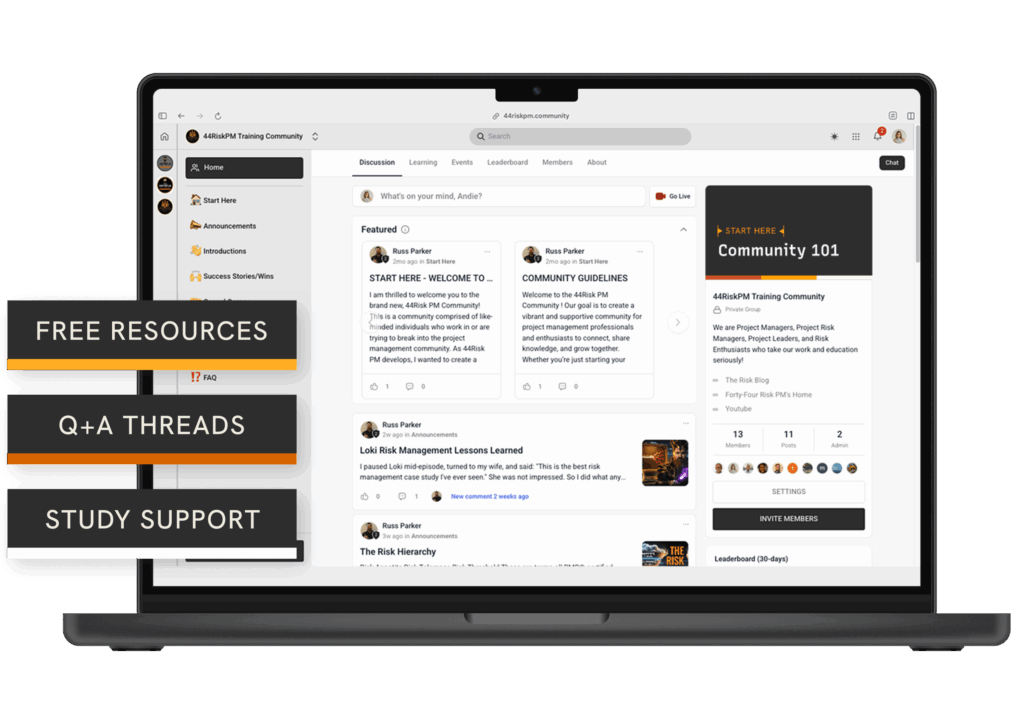
        Looking for free resources and support?

        Whether you’re just starting or deep into studying, the 44Risk PM community gives you access to free resources, structured guidance, and a place to ask real questions. No pressure. Just practical support.