RMP Prep

PMI-RMP Exam Content Outline (ECO) Explained

PMI RMP ECO Explained
You’ve committed to earning your PMI Risk Management Professional (PMI-RMP) certification. You’ve reviewed the eligibility requirements, calculated your study timeline, and maybe even purchased prep materials.
 
But here’s the critical question most candidates overlook: 
Are you studying what’s actually on the exam?
 
Every year, thousands of prepared, competent project professionals fail the PMI-RMP exam—not because they lack risk management knowledge, but because they studied the wrong things in the wrong way.
Or they treated the PMI-RMP as a simplier exam than the PMP vs. an exam that dives deeper into a complicated short portion of the PMP exam.
 
The difference between passing and failing often comes down to one strategic document: the PMI-RMP Exam Content Outline (ECO).
 
This guide explains exactly what the Exam Content Outline is, why it’s your most valuable study resource, and how to use it strategically to pass the PMI-RMP exam with confidence.

What is the PMI-RMP Exam Content Outline?

The PMI-RMP Exam Content Outline (ECO) is the official blueprint for the Risk Management Professional certification exam, published and maintained by the Project Management Institute.
 
Think of it as the authoritative specification document that defines:
  • What knowledge a competent risk management professional must possess
  • What tasks they must be able to perform in real-world scenarios
  • How those competencies are assessed and evaluated on the exam
  • What weight each domain carries in the overall examination
PMI uses the ECO to design every exam question, validate content relevance, and ensure consistent scoring across all test administrations.

The Critical Truth About the PMI-RMP ECO

Here’s what this means for your preparation:
If a topic is in the ECO—regardless of how minor it seems—it’s fair game for testing.
 
This makes the Exam Content Outline the single most important reference document in your entire PMI-RMP study process.
 
Yet most candidates download it once, skim it briefly, and never reference it again.
 
That’s a strategic mistake that has a risk of costing you weeks of misdirected study effort.

How PMI Develops the Exam Content Outline

Understanding how PMI creates the ECO reveals why it’s so reliable as a study guide.

The Project Management Institute conducts extensive role delineation studies every few years, involving:
  1. Subject matter expert panels of practicing risk professionals across industries
  2. Global surveys of PMI-RMP holders and risk management practitioners
  3. Statistical validation of task frequency and criticality
  4. Industry analysis of emerging risk management practices
The result is a rigorously validated blueprint that reflects current, real-world risk management professional practice—not academic theory or outdated methodologies.
 
Current ECO Version: The most recent PMI-RMP Exam Content Outline was published in 2023 and remains the active version until PMI updates it.

The Three-Tier Structure of the PMI-RMP Exam Content Outline

The ECO isn’t just a list of topics. It’s organized in a hierarchical framework that mirrors how risk professionals actually work:

Tier 1: Domains (The "What")

Domains represent the major areas of professional responsibility in risk management. Think of these as the high-level categories of competency.

The PMI-RMP exam is organized around five domains, each covering a distinct phase or aspect of project risk management.

Tier 2: Tasks (The "Why")

Tasks describe what a risk management professional is expected to accomplish within each domain. These are the observable activities and responsibilities that demonstrate competency.
 
Each domain contains multiple tasks—19 tasks total across all five domains.

Tier 3: Enablers (The "How")

Enablers are the specific knowledge, skills, tools, and techniques required to perform each task effectively.
 
This is where the exam gets granular. There are 93 enablers spread across all tasks—and this is where most candidates have knowledge gaps.

Why This Structure Matters for Exam Preparations

Most PMI-RMP candidates make a critical study mistake: they memorize tools and techniques in isolation.
 
High-performing candidates study differently: They understand each enabler in the context of its task and domain. They know not just what Monte Carlo simulation is, but when to apply it, why it matters, and how it supports specific risk management tasks.
 
This contextual understanding is exactly what the PMI-RMP exam tests.

The Five Domains of the PMI-RMP Exam (With Exam Weightings)

Domain I: Risk Strategy and Planning (22% of the Exam)

What it covers: Establishing the strategic foundation for risk management on projects and programs.
 
Core competencies tested:
  • Developing risk management strategies aligned to organizational objectives
  • Defining risk appetite, risk tolerance, and risk thresholds
  • Establishing governance structures, roles, and responsibilities
  • Creating escalation paths and decision frameworks
  • Integrating risk management into overall project planning
Number of tasks: 6
Number of enablers: 36
 
Exam insight: This domain contains more conceptual, strategy-level questions than calculation-based questions. PMI tests your ability to align risk management with organizational context—not just execute processes mechanically.
 
Common question types:
  • Which risk management approach best aligns with organizational risk appetite?
  • How should risk roles and responsibilities be defined for this scenario?
  • What governance structure supports effective risk escalation?
Why candidates struggle here: Many project managers are accustomed to tactical execution. This domain requires strategic thinking about how risk management integrates with organizational objectives and governance.

Domain II: Risk Identification (23% of the Exam)

What it covers: Proactively uncovering and documenting project threats and opportunities.
 
Core competencies tested:
  • Applying structured identification techniques (brainstorming, Delphi, interviews, checklists)
  • Leveraging stakeholder knowledge and expertise
  • Analyzing assumptions and constraints
  • Identifying both threats and opportunities
  • Documenting risks with sufficient detail for analysis
Number of tasks: 4
Number of enablers: 17
 
Exam insight: PMI strongly favors systematic, repeatable identification approaches over informal methods. The exam tests whether you can select the most appropriate technique for a given project context.
 
Common question types:
  • Which identification technique is most effective for this situation?
  • How should stakeholders be engaged in risk identification?
  • What’s missing from this risk description?
Why candidates struggle here: Confusion between identification techniques and analysis techniques. Many candidates also underestimate the importance of stakeholder-driven identification approaches.

Domain III: Risk Analysis (23% of the Exam)

What it covers: Assessing and prioritizing risks to determine where to focus response efforts.
 
Core competencies tested:
  • Distinguishing between qualitative and quantitative analysis
  • Assessing probability and impact using appropriate scales
  • Calculating expected monetary value (EMV)
  • Performing sensitivity analysis
  • Interpreting Monte Carlo simulation results
  • Prioritizing risks based on exposure and criticality
  • Using decision trees for complex scenarios
Number of tasks: 3
Number of enablers: 15
 
Exam insight: This is the highest-weighted domain and where most quantitative questions appear. You must understand not just how to perform calculations, but when each analysis approach is appropriate and what the results mean for decision-making.
 
Common question types:
  • Which analysis method is most appropriate for this scenario?
  • Given this probability and impact, what’s the expected monetary value?
  • How should these analysis results inform response prioritization?
  • What does this sensitivity analysis reveal about project risk?
Why candidates struggle here: Insufficient practice with quantitative concepts. Many candidates can define EMV but can’t apply it to complex, multi-layered scenarios where multiple risks interact.

Domain IV: Risk Response (13% of the Exam)

What it covers: Converting risk analysis insights into actionable strategies and response plans.
 
Core competencies tested:
  • Selecting appropriate response strategies (avoid, mitigate, transfer, accept, exploit, enhance, share)
  • Evaluating response cost-effectiveness
  • Assigning risk ownership and accountability
  • Integrating responses into project plans and budgets
  • Developing contingent response plans
  • Calculating and justifying contingency reserves and management reserves
Number of tasks: 2
Number of enablers: 12
 
Exam insight: PMI emphasizes decision logic over memorized definitions. You need to know not just what each response strategy is, but which one creates optimal value given specific constraints, resources, and organizational context.
Common question types:
  • Which response strategy is most appropriate for this risk?
  • How should response ownership be assigned?
  • What’s the most cost-effective approach to reduce this risk exposure?
  • How should contingency reserves be calculated for this scenario?
Why candidates struggle here: Difficulty selecting between similar response strategies (e.g., when to mitigate vs. transfer). Candidates also struggle with questions that require balancing cost, effectiveness, and organizational constraints.

Domain V: Monitor and Close Risk (19% of the Exam)

What it covers: Tracking risk throughout the project lifecycle and capturing lessons learned.
 
Core competencies tested:
  • Monitoring residual risks and secondary risks
  • Conducting risk reassessments and audits
  • Reporting risk status to stakeholders
  • Updating risk management plans based on changes
  • Closing risks and documenting outcomes
  • Capturing and sharing lessons learned
Number of tasks: 4
Number of enablers: 13
 
Exam insight: Despite the lower weighting, don’t ignore this domain. Questions often test governance awareness, reporting cadence, and change management integration.
 
Common question types:
  • How should risk status be reported to this stakeholder group?
  • What triggers a risk reassessment?
  • How should secondary risks be managed?
  • When is it appropriate to close a risk?
Why candidates struggle here: Underestimating the domain due to low weighting, leading to avoidable missed questions. Also, confusion about residual vs. secondary risks.

Task and Enablers: Where the PMI-RMP Prep is Actually Won!

While domains provide the high-level structure, enablers are where the exam is actually won or lost.

Understanding Tasks in Context

Each domain contains specific tasks that describe what risk professionals do in practice. For example, within Domain 3 (Risk Analysis), tasks include:
  • Perform Qualitative Risk Analysis
  • Perform Quantitative Risk Analysis
  • Identify Threats and Opportunities

Why Enablers are Your Secret Weapon

Enablers are the knowledge, skills, tools, and techniques that allow you to perform each task competently.
For the task “Perform quantitative analysis to evaluate overall project risk exposure,” enablers include:
  • Analyze risk data and process performance information against established metrics
  • Analyze a project’s general risks
  • Perform a forecast and trend analysis on new and historical information
  • Perform sensitivity analysis
    • Monte Carlo, decision trees, critical path, expected monetary value, etc.
  • Perform risk weighting and calculate risk priority
Here’s the strategic insight most candidates miss:
There are 93 enablers across the entire Exam Content Outline. If you can:
  1. Explain each enabler in plain language
  2. Recognize it in a scenario-based question
  3. Apply it appropriately to a project situation
You’re studying at an exam-ready level.

The Enabler Competency Framework

For each of the 93 enablers, develop three levels of mastery:
Level 1: Recognition
  • Can you identify the enabler when it’s named?
  • Do you know its basic definition?
Level 2: Comprehension
  • Can you explain when and why to use it?
  • Do you understand its purpose in the risk management process?
Level 3: Application
  • Can you select it as the appropriate tool in a scenario?
  • Can you interpret results or outputs from its use?
The PMI-RMP exam tests primarily at Levels 2 and 3—comprehension and application, not just recognition.

How to Use the PMI-RMP Exam Content Outline as a Strategic Study Tool

Most candidates read the ECO once and file it away. Successful candidates work the ECO actively throughout their preparation.
 
Here’s a proven, exam-aligned approach:

Step 1: Download and Print the Official ECO

Where to get it: Download the official PMI-RMP Exam Content Outline directly from PMI.org (free PDF).
 
Why print it: A physical copy allows you to annotate, highlight patterns, track confidence levels, and create a visual study roadmap. Digital highlighting doesn’t create the same cognitive engagement.

Step 2: Read Every Enabler with Active Questioning

Don’t passively skim. For each enabler, ask yourself:
  • Can I explain this without technical jargon?
  • Have I applied this on a real project?
  • Could I recognize this in a scenario-based exam question?
  • Do I know when to use this vs. similar alternatives?
If you answer “no” or “unsure” to any question, you’ve identified a study gap.

Step 3: Color-Code Your Confidence Level by Domain

Create a visual confidence map using a simple system:

🔴 Red: Weak understanding or no practical experience
🟡 Yellow: Familiar but uncertain—needs deeper study
🟢 Green: Confident and can apply in scenarios
 
This becomes your personalized study roadmap. Focus 80% of study time on red and yellow areas.

Step 4: Map Real-World Experience to Enablers

The PMI-RMP is not a pure memorization exam. It tests professional judgment.
 
For each enabler, connect it to your actual project experience:
  • When have I used this technique?
  • What project challenges did it address?
  • What were the results or outcomes?
This experiential mapping dramatically improves recall and scenario recognition on exam day.

Step 5: Study One Domain at a Time (Don't Topic-Hop)

Avoid scattered, random topic jumping. Domain-based study builds contextual understanding—the exact cognitive skill PMI tests.
 
Recommended study sequence:
  1. Domain 1 (Strategy and Planning) – establishes foundation
  2. Domain 2 (Identification) – builds on strategy
  3. Domain 3 (Analysis) – deepest content, needs most time
  4. Domain 4 (Response) – applies analysis insights
  5. Domain 5 (Monitor and Close) – completes the lifecycle
This sequence mirrors the natural flow of risk management work.

Step 6: Reverse-Engineer Every Practice Question

After each practice exam question (correct or incorrect), perform this analysis:
  • Which domain does this question test?
  • Which specific task is being assessed?
  • Which enabler(s) would help answer this correctly?
Missed the question? You’ve just identified your next study priority. Go back to the ECO and master that enabler in context.
 
This reverse-engineering process is how top performers turn practice exams into precision study tools.

Step 7: Track Domain Performance Over Time

Create a simple tracking spreadsheet:


Domain


Practice Exam 1


Practice Exam 2


Practice Exam 3


Target


Domain 1


68%


75%


82%


80%+


Domain 3


58%


65%


78%


75%+


Why this matters: The PMI-RMP doesn’t publish domain-specific pass/fail scores, but you need strong performance across ALL domains. A 90% in Domain 1 won’t offset a 50% in Domain 3.

Common PMI-RMP ECO Mistakes (And How to Avoid Them)

Mistake 1: Treating the ECO as Optional Background Reading

The problem: Candidates download the ECO, skim it once, then rely entirely on third-party study guides.
 
Why it fails: Third-party materials may emphasize different topics or use different terminology than PMI. The ECO is the source of truth.
 
The fix: Make the ECO your primary reference. Use study guides to supplement and explain—not replace—the official content outline.

Mistake 2: Studying Enables in Isolation

The problem: Memorizing definitions of tools without understanding their task context.
 
Why it fails: The exam doesn’t ask “What is Monte Carlo simulation?” It asks “Which analysis approach should you use in this scenario?” Context matters.
 
The fix: Always study enablers within their task and domain context. Understand why and when, not just what.

Mistake 3: Ignoring Lower-Weighted Domains

The problem: Spending minimal time on Domain 5 (Monitor and Close) because it’s only 6% of the exam.
 
Why it fails: 6% still represents 10+ questions. Missing most of them makes passing significantly harder.
 
The fix: Allocate study time proportional to weighting, but ensure basic competency in ALL domains.

Mistake 4: Not Tracking Enabler Mastery

The problem: Studying randomly without systematic tracking of which enablers you’ve mastered.
 
Why it fails: You waste time re-studying what you already know while leaving gaps unaddressed.
 
The fix: Create an enabler checklist. Mark each as you achieve Level 2-3 mastery (comprehension and application).

Mistake 5: Confusing the eCO with the PMBOK® Guide

The problem: Assuming PMBOK® Guide risk chapters are sufficient preparation.
 
Why it fails: The PMI-RMP goes significantly deeper than PMBOK® Guide risk content. The ECO defines additional tasks and enablers not covered in PMBOK®.
 
The fix: Use PMBOK® Guide as foundational reference, but the ECO must drive your study plan.

How the PMI-RMP ECO Connects to the Actual Exam

Understanding how ECO content translates to exam questions helps you study more strategically.

Exam Format and Structure

  • 115 questions (multiple choice, four options each)
  • 2.5 hours of testing time
  • Computer-based testing at Pearson VUE centers or online proctoring
  • Scenario-based questions that test application, not just recall

Question Distribution by Domain

Based on the ECO weightings:
Domain
Weight
Approximate Questions
Domain 1: Risk Strategy & Planning
22%
~26 questions
Domain 2: Risk Identification
23%
~26 questions
Domain 3: Risk Analysis
23%
~26 questions
Domain 4: Risk Response
13%
~15 questions
Domain 5: Monitor & Close
19%
~22 questions
Note: These are approximations.

How ECO Tasks Become Exam Questions

PMI translates ECO tasks into scenario-based questions that test your professional judgment:
 
ECO Task (Domain 3): “Perform quantitative analysis to evaluate overall project risk exposure”
 
Becomes exam question: “Your $12M construction project has 15 identified risks. Schedule analysis shows 70% probability of completing within baseline. Cost analysis shows mean project cost of $13.2M. What’s the most appropriate next step?”
 
The question tests whether you can interpret quantitative analysis results and select the appropriate risk response action.

How Enablers Appear in Questions

Enablers show up both explicitly and implicitly:
 
Explicit: “Which technique should the risk manager use to analyze this situation?” (testing knowledge of specific enabler)
 
Implicit: The scenario describes a situation where Monte Carlo simulation has been performed. You need to recognize the output and interpret it correctly without the question naming the technique.

PMI-RMP ECO Study Resources and References

Here are the official resources you need for your exam preparations:

PMI-RMP Exam Content Outline (FREE)

  • Download from PMI.org
  • Updated in 2023
  • 17 pages of detailed domain, task, and enabler breakdowns

PMI-RMP Examination Reference List

Within the ECO, 

  • PMI publishes a list of references that informed ECO development
  • Includes Practice Standard for Project Risk Management
  • PMBOK® Guide risk management chapters

Creating your ECO-Based Study Plan

The Exam Content Outline isn’t just a reference—it’s the blueprint for your entire preparation strategy.

Phase 1: ECO Familiarization

  • Read the complete ECO thoroughly
  • Identify unfamiliar enablers
  • Assess confidence level by domain
  • Create your initial study roadmap

Phase 2: Domain Deep Dive

  • Study one domain at a time
  • Master all enablers within context
  • Complete domain-specific practice questions
  • Track performance by domain
Time allocation by domain:
  • Domain 1: 1.5 weeks
  • Domain 2: 1.5 weeks
  • Domain 3: 2 weeks (highest weight, most complex)
  • Domain 4: 1.5 weeks
  • Domain 5: 1 week

Phase 3: Integration and Practice

  • Full-length practice exams
  • Reverse-engineer missed questions to ECO
  • Re-study weak enablers
  • Final domain performance checks

Phase 4: Final Review

  • Quick review of all 93 enablers
  • Focus on previously weak areas
  • Light practice to maintain readiness
  • Exam logistics preparation

Key Takeaways: Why the ECO is Your Competitive Advantage

The PMI-RMP Exam Content Outline is not optional reading—it’s the definitive blueprint for certification success.

When you align your preparation to the ECO:
✅ You study what actually matters instead of wasting time on tangential topics
✅ You recognize exam patterns instead of memorizing disconnected facts
✅ You build contextual understanding instead of superficial knowledge
✅ You walk into the exam with clarity, confidence, and control instead of anxiety
 
The ECO transforms your preparation from scattered effort into strategic execution.

The Bottom Line: Master the ECO, Master the Exam

The difference between candidates who pass the PMI-RMP and those who don’t often comes down to a single strategic choice:

Did they build their study plan around the official Exam Content Outline—or did they wing it with random materials?
 
Every task matters. Every enabler matters. Every domain matters.
 
The PMI-RMP exam is entirely predictable—if you know where to look. The ECO tells you exactly what to study, in what context, and why it matters.
 
Don’t gamble on fragmented prep materials or outdated study guides. 
 
Anchor your entire preparation strategy to the official PMI-RMP Exam Content Outline.

Ready to Transform the ECO Into your Passing Strategy?

Get Your PMI-RMP Exam Prep with Russ

Get your 30 contact hours required for the PMI-RMP with Russ. Taught over two weekends, the course covered the ENTIRE Exam Content Outline and comes with a review of your application + a practice exam! 
Learn More About Forty-Four Risk PM, LLC at: https://44riskpm.com/home/

Nice to meet you, I’m Russ Parker.

PMP®, PMI-RMP®, PMI-ACP®
PMI-ATP Instructor – PMP® & PMI-RMP®

This analysis was prepared by 44Risk PM LLC, specializing in PMI-RMP® and PMP® certification training with a focus on practical, real-world risk management.

An Approved PMI-Authorized Training Partner

Connect with me on Linkedin
Subscribe to my YouTube
Find me on Substack

“Stay Proactive Over Reactive”

“The PMI-Authorized Training Partner seal, PMP®, PMI-RMP®, and PMI-ACP® are registered marks of the Project Management Institute, Inc.”

Related Posts

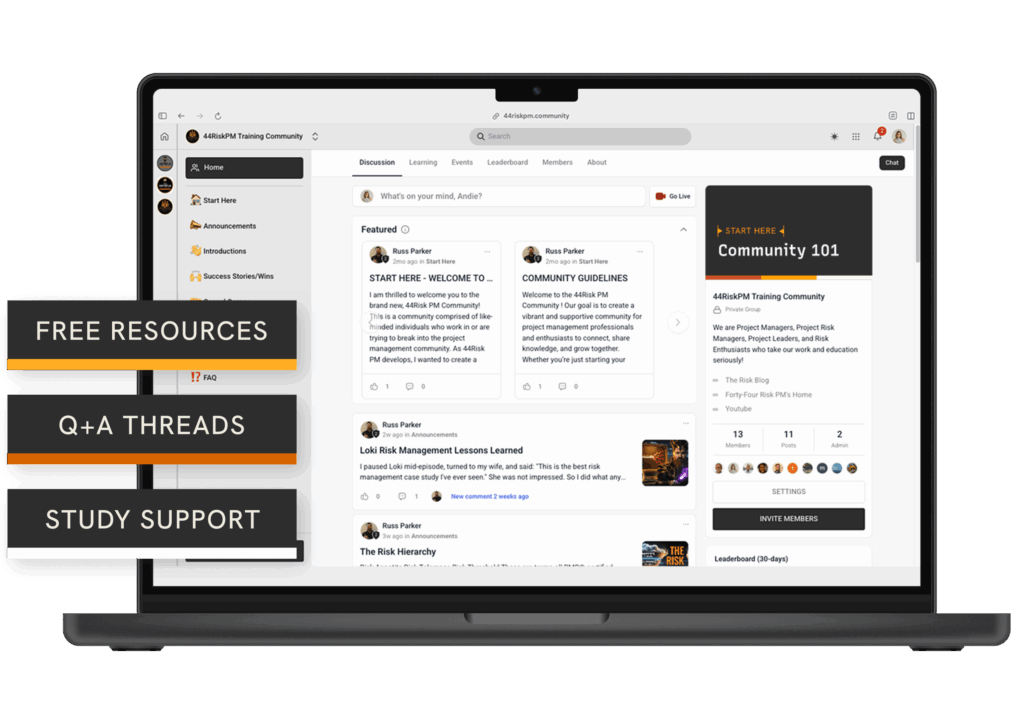
Looking for free resources and support?

Whether you’re just starting or deep into studying, the 44Risk PM community gives you access to free resources, structured guidance, and a place to ask real questions. No pressure. Just practical support.