Why Smart Project Managers Still Fail PMI Exams (And How to Fix It)
I watched a friend take the PMP exam three times before he finally passed.
He wasn’t unprepared. This guy managed multi-million dollar programs, led cross-functional teams, and could recite the PMBOK® Guide in his sleep. But every practice exam, he’d hover around 65-70%—just under the passing threshold.
His problem wasn’t knowledge.
It was thinking.
Every time he read a scenario question, his brain defaulted to what worked on his projects—not what PMI expected. He’d choose the answer that solved the immediate problem instead of the one that followed PMI’s process logic.
Sound familiar?
Here’s the thing most candidates miss: PMI exam cognitive biases are engineered into every question. The exam doesn’t reward real-world instincts. It tests whether you can suppress your experience-based reflexes and think like PMI—even when it feels counterintuitive.
If you’ve been managing projects for years and PMI certifications still feel unfairly difficult, you’re not alone. You’re just fighting the wrong battle.
This article breaks down:
- The psychological traps deliberately built into PMP and PMI-RMP exam questions
- The specific cognitive biases those traps exploit
- A 6-step decision framework you can use to neutralize them on exam day
I’ve spent 15+ years in project management and earned both my PMP and PMI-RMP. This framework is what finally clicked for my friend, and what I teach inside my exam prep courses.
The Hidden Psychological Design of PMI Exam Questions
Every PMI multiple-choice question follows the same deceptive structure:
1 correct answer
3 distractors
But here’s what separates candidates who pass from those who don’t:
Distractors aren’t random.
They’re intentionally engineered to feel reasonable, familiar, and emotionally satisfying—especially under time pressure. Each distractor targets a specific cognitive bias that experienced project managers are most likely to have.
Think about it: If you’ve managed projects successfully for a decade, you’ve developed mental shortcuts. You recognize patterns. You trust your gut.
PMI exam cognitive biases exploit exactly that.
Once you see this design, the exam stops feeling unpredictable. It starts feeling tactical. You stop asking “What’s the right answer?” and start asking “Which bias is this question trying to trigger?”
That shift changes everything.
The Four Distractor Types PMI Uses to Manipulate Your Decision-Making
1. The Technically True Distractor
This option is factually correct—but completely irrelevant.
It often:
- Describes something that could be done
- References a valid PMI concept or artifact
- Sounds “PM-ish” enough to pass a surface check
But it doesn’t answer the question being asked.
Real example from practice exams:
Question: “The project is behind schedule. What should the project manager do FIRST?”
Technically True Distractor: “Update the lessons learned register.”
Is updating lessons learned a valid PM activity? Absolutely. Does it address a schedule problem first? No. PMI wants you to assess the variance, evaluate options, and possibly adjust the schedule baseline—not document reflections.
PMI doesn’t reward correctness in isolation. It rewards contextual correctness.

2. The Real-World Experience Distractor (The Most Dangerous Trap)
This is where veteran PMs get burned.
These answers align with:
- What you’ve actually done in real projects
- What worked under real constraints
- What you’d instinctively do Monday morning
Here’s the brutal truth: PMI certifications don’t test how you manage projects. They test how PMI expects projects to be managed.
My friend who failed twice? He kept choosing answers like “Address the issue immediately to keep the project moving.” In the real world, that’s often correct. In PMI’s world, you’re supposed to:
- Assess root cause
- Review relevant plans
- Engage appropriate stakeholders
- Document the decision
Then act.
If an option skips formal assessment, stakeholder analysis, or documented review—even if it feels practical—it’s likely exploiting your experience bias.
The fix: When you see an answer that matches your instinct, ask yourself: “Did I follow PMI’s process, or did I skip steps because I already ‘know’ what to do?”
3. The Emotionally Satisfying Distractor
These answers feel good.
They:
- “Fix” the obvious problem
- Sound decisive and proactive
- Appeal to action bias (“Do something—now“)
PMI questions often describe stressful scenarios on purpose. A stakeholder is angry. A deadline is missed. A risk materialized.
Under stress, your brain craves closure.
PMI wants restraint.
If an answer rushes to action without analysis, escalation, or process alignment, it’s probably exploiting your emotional response—not rewarding good judgment.
Example:
Scenario: A team member publicly criticizes your leadership during a meeting.
Emotionally Satisfying Answer: “Address the behavior immediately in the meeting.”
PMI’s Answer: “Speak with the team member privately after the meeting.”
One feels decisive. The other follows conflict resolution best practices. Guess which one PMI rewards?
4. The Keyword Match Distractor
This option mirrors the language of the question.
It:
- Repeats familiar terms
- Echoes framework names (Agile, Scrum, risk register, change control)
- Creates a false sense of alignment
Keyword overlap does not equal correctness.
PMI tests intent, not vocabulary. If the logic doesn’t follow PMI’s expected decision path, matching words won’t save you.
The Cognitive Biases PMI Exam Questions Exploit (And How to Recognize Them)
PMI isn’t just testing project management. It’s testing human psychology.
Understanding these PMI exam cognitive biases is half the battle:
Action Bias
You feel compelled to do something immediately—even when PMI expects analysis, review, or validation first.
Availability Heuristic
You choose the answer that matches your most recent or memorable project experience, not PMI’s process logic.
The trap: “This worked on my last project, so it must be right here.”
Stress Induced Systems Thinking
Under time pressure, your brain defaults to fast, intuitive thinking instead of slow, structured reasoning—exactly when PMI wants discipline.
The trap: Trusting your gut when you should trust the framework.
See These Biases in Action Before Exam Day
Most candidates don’t realize they’re falling for PMI exam cognitive biases until they’ve already failed. Don’t be one of them.
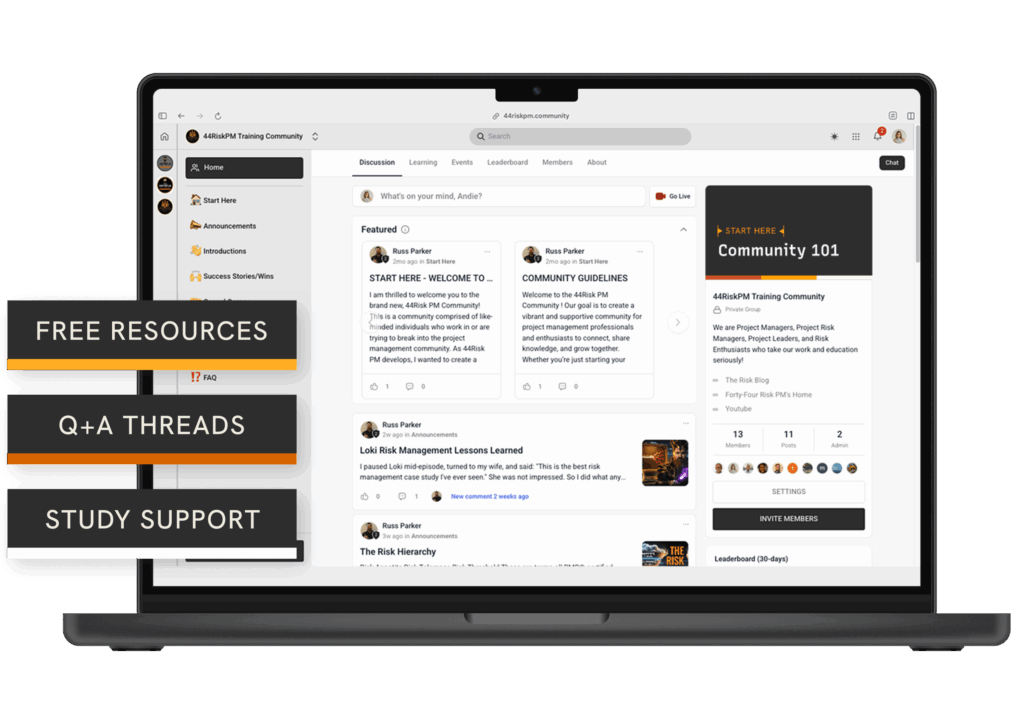
Join the 44Risk PM Prep Lab Community (it’s free) and get access to:
- Real exam-style questions with bias breakdowns
- Monthly live Q&A sessions
- A community of PMs learning to think like PMI
Already deep in exam prep? Keep reading for the exact framework that helped my friend finally pass.
The PMI Bias Override Framework™: A 6-Step Decision Filter for Exam Day
Use this process on every situational question—whether you’re taking the PMP, PMI-RMP, or any PMI certification exam:
Step 1: Read the Last Sentence First
Identify exactly what PMI is asking before absorbing the noise.
The scenario is often a psychological decoy. The question stem is what matters.
Step 2: Identify the Question Type
Is this about:
- Risk response?
- Stakeholder engagement?
- Governance?
- Escalation?
- Process sequencing?
Different question types demand different mental models. A risk question expects risk assessment tools. A stakeholder question expects engagement strategies.
Step 3: Answer the Question in Your Head (Before Looking at the Answers)
Before looking at the multiple-choice options, decide what should happen according to PMI logic.
This prevents anchoring. If you read the options first, your brain starts rationalizing why each one could work instead of eliminating what won’t.
Step 4: Eliminate with Intent
Don’t ask “Which is right?”
Ask “Why is this wrong?”
Actively disqualify options based on:
- Skipped process steps
- Premature action
- Experience-based shortcuts
Three wrong answers are easier to spot than one right answer.
Step 5: Distrust the Obvious Answer
If an option feels immediately satisfying, slow down.
PMI rarely rewards impulse. The correct answer often feels slightly less exciting because it requires one more step of analysis or documentation.
My friend’s breakthrough moment? When he started treating his first instinct as a red flag instead of confirmation.
Step 6: When Torn Between Two, Choose Process Over Action
When two answers seem plausible, PMI almost always favors:
- Assessment before response
- Documentation before execution
- Structured engagement over heroics
If one option says “Do X” and another says “Review Y, then do X,” the second one wins 80% of the time.
Final Thought: Think Like PMI—Not Like a Veteran PM
Your real-world project management experience is valuable.
It’s what makes you good at your job.
It’s why you’re pursuing PMI certifications in the first place.
But on exam day? It has to wait outside the testing room.
The candidates who pass PMP and PMI-RMP exams don’t out-memorize the rest. They out-discipline their own instincts. They recognize when their brain is being baited by PMI exam cognitive biases—and they override the reflex.
Once you see PMI questions for what they are—psychological filters disguised as multiple choice—the exam stops being mysterious.
It becomes manageable.
Then predictable.
Then winnable.
Ready to Train This Thinking Pattern Before Exam Day?
This cognitive framework isn’t something you read once and master. It’s a skill you drill through practice, debrief, and repetition—exactly what we do inside:
44RiskPM Exam Prep Courses:
✅ Exam simulations designed to expose your cognitive biases
✅ Question debriefs that show you why wrong answers felt right
✅ Risk-focused prep for both PMP® and PMI-RMP® certifications
Not ready to commit yet? Start here:
The difference between passing and failing isn’t knowledge.
It’s thinking like PMI instead of thinking like yourself.
Once you master that, PMI exam cognitive biases stop being traps.
They become predictable patterns you dismantle—one question at a time.
About 44Risk PM, LLC
This analysis was prepared by 44Risk PM LLC, specializing in PMI-RMP® and PMP® certification training with a focus on practical, real-world risk management.
Contact:
Russ Parker
PMP®, PMI-RMP®, PMI-ACP®
PMI-ATP Instructor – PMP® & PMI-RMP®
Owner, Forty-Four Risk PM, LLC
Connect with me on Linkedin
Subscribe to my YouTube
“Stay Proactive Over Reactive”

——————————————————————————–
The PMI Authorized Training Partner seal, PMI, PMP, PMI-RMP, and PMI-ACP are registered marks of the Project Management Institute, Inc.