Are you on your PMP Journey?
When you first discover the world of project management certifications and find yourself surrounded by success stories from people like Roberto, it can be easy to feel intimidated—especially if you’re wondering whether your moment has already passed.
I’m here to tell you: it hasn’t.
Instead of letting comparison discourage you, let Roberto’s journey serve as inspiration and fuel for your own certification ambitions.
Pour yourself a cup of coffee and settle in as we explore how one project professional transformed determination into credential—proving that the best time to pursue your PMP certification might be right now.
Roberto Excelled Where Many Candidates Struggle
There are countless stories of PMP candidates who start strong and fade before exam day. The certification’s breadth, the demanding study schedule, and the challenge of balancing preparation with life’s other responsibilities derail even talented project professionals.
When Roberto first committed to pursuing his PMP certification at age 51, he could have easily found reasons to delay. A full-time job. Family responsibilities. The sheer volume of material the PMP exam covers.
If I faced those obstacles, I might have convinced myself to wait for a “better time.” But Roberto approached this challenge with a different mindset entirely.
How can you avoid feeling discouraged when circumstances seem stacked against you?
Take a page from Roberto’s approach, because as he demonstrated: the obstacles that feel insurmountable often become manageable with the right strategy.
Roberto's Success Story: More Than an Exam
Roberto’s motivation for pursuing the PMP certification didn’t come from his employer or a job requirement. It came from within.
“For me, PMP is really more than an exam; it’s a milestone. It’s very important to achieve that,” he shared.
This perspective matters. Roberto viewed the certification as a demonstration of his ability to achieve goals despite his age—proof that continuous learning and growth remain possible at any stage in life.
That intrinsic motivation made all the difference when the study sessions grew long and the material grew complex.
The Approach: Discipline Over Intensity
Like any successful certification candidate, Roberto did things a little differently from those who struggle.
With a busy life that included family and a full-time job, Roberto couldn’t dedicate entire weekends to cramming. Instead, he committed to one hour of focused study every single day.
“Without a clear plan and vision, it’s not so easy to achieve that,” he noted.
This consistency-over-intensity approach allowed Roberto to build momentum without burning out. Rather than sporadic marathon sessions that leave candidates exhausted and discouraged, his daily habit created sustainable progress.
Roberto also credited the quality of his training, highlighting the importance of engaging instruction when tackling such an extensive body of knowledge.
“I appreciated the energy that you put into the lessons,” he told his instructor, Russ. “The PMP is huge in terms of topics, and with a good guide, it becomes better for sure.”

The PMP Mindset Shift: Thinking Like PMI
One of Roberto’s most valuable insights involved the cognitive adjustment required for PMP exam success.
“You need to think as PMI persona. Sometimes in reality, it is not the same, but you need to think like them,” he explained.
This distinction trips up many experienced project managers. Real-world project decisions often differ from PMI’s recommended approaches. Candidates who rely solely on their practical experience—without understanding PMI’s perspective—frequently select answers that feel right but aren’t what PMI considers correct.
Roberto recognized this gap and trained himself to adopt PMI’s reasoning framework, even when it conflicted with how decisions might unfold in his actual work environment.
Training for a Marathon, Not a Sprint
Roberto likened exam preparation to training for a marathon—and the analogy extends beyond just the study period.
“You need to train to stay a lot of time, sit down, and answer the questions,” he advised.
The PMP exam demands endurance. Candidates must maintain focus and analytical thinking across hours of scenario-based questions. Roberto emphasized the importance of practicing under timed conditions, building the stamina required to perform consistently from the first question to the last.
This meant taking full-length practice exams, not just reviewing content. It meant sitting through the discomfort of extended testing periods so that exam day felt familiar rather than overwhelming.
Exam Day: Ending the PMP Journey
When exam day arrived, Roberto chose to test at a center rather than at home. He believed the controlled environment would help him stay focused and minimize distractions.
Despite his preparation, nerves showed up—as they do for virtually every candidate.
“After 10 or 20 questions, I was more relaxed because I understood that I was able to answer,” he recalled.
That early anxiety gave way to confidence as Roberto recognized that his preparation had worked. He also took advantage of the scheduled breaks to refresh himself—a simple but essential strategy for maintaining focus across the exam’s duration.
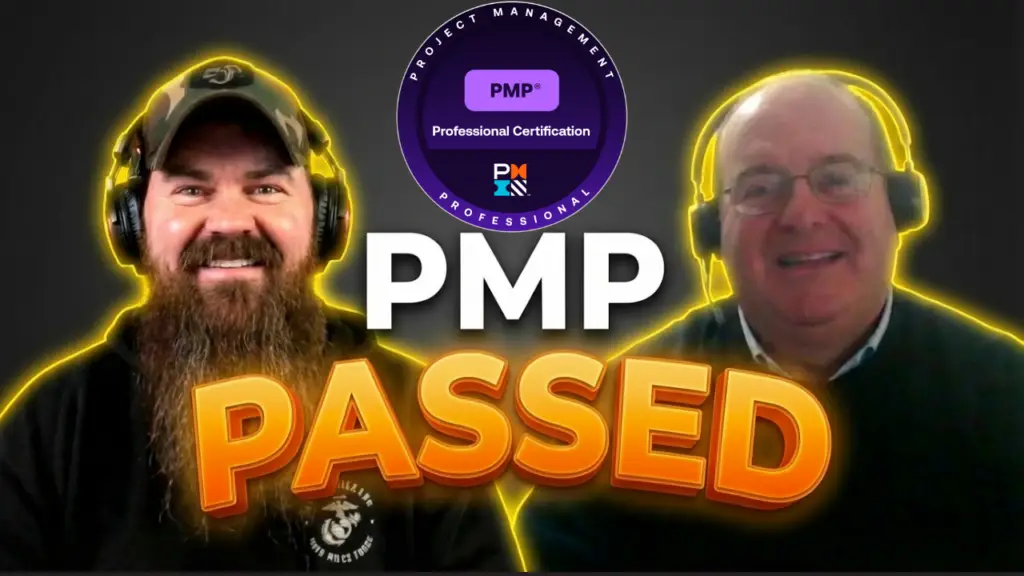
The result: Roberto passed.
Roberto's Advice for Future PMP Candidates
Reflecting on his journey, Roberto offered three pieces of guidance for those considering the PMP certification:
Set Your Exam Date
“Fix the exam date. If you don’t, January becomes February, and so on,” he cautioned.
Without a concrete deadline, preparation becomes open-ended and your PMP Journey has no endpoint. Setting an exam date transforms a vague intention into a specific commitment with accountability built in.
Practice With Quality PMP Simulators
Roberto emphasized practicing extensively with good simulators and analyzing the reasoning behind answers, not just memorizing whether you got questions right or wrong.
Understanding why PMI considers certain answers correct reinforces the thinking patterns required for exam success.
Release the Need for Perfection
“In some way, you have to say: I have to go and do it.”
Roberto encouraged candidates to stop waiting for the perfect moment or perfect preparation. At some point, you’ve done the work. Trust your preparation and take the exam.
Wrapping This PMP Journey Up
Roberto’s PMP journey to earning his certification demonstrates what becomes possible with determination, planning, and consistent practice.
His experience reinforces several principles that apply whether you’re pursuing the PMP, the PMI-RMP, or any professional certification:
Age should never be a barrier to pursuing new challenges. With the right mindset and resources, success is within reach. Consistency beats intensity. And sometimes, the most important step is simply deciding to go and do it.
People like Roberto are precisely why I do what I do.
I knew there was a need for project professionals who want more than generic exam prep—practitioners who deserve guidance that respects their experience while preparing them for certification success.
If you’re contemplating your own certification journey, remember Roberto’s formula: set a clear goal, stay disciplined in your studies, and practice until the exam feels like familiar territory.
Your milestone is waiting.
Use the button below to see my upcoming PMP® Exam Prep Course Schedule.
About 44Risk PM, LLC
This analysis was prepared by 44Risk PM LLC, specializing in PMI-RMP® and PMP® certification training with a focus on practical, real-world risk management.
Contact:
Russ Parker
PMP®, PMI-RMP®, PMI-ACP®
PMI-ATP Instructor – PMP® & PMI-RMP®
Owner, Forty-Four Risk PM, LLC
An Approved PMI-Authorized Training Partner
Connect with me on Linkedin
Subscribe to my YouTube
Find me on Substack
“Stay Proactive Over Reactive”
“The PMI-Authorized Training Partner seal, PMP®, PMI-RMP®, and PMI-ACP® are registered marks of the Project Management Institute, Inc.”