The Vocabulary Problem Around Risk vs. Issue That Scales Badly
In enterprise environments, “Risk vs. Issue” miscommunication compounds. A single misclassified item in a status report travels up through layer after layer of stakeholders, directors, sponsors, C-suite, before anyone catches the error. By then, the damage is done: credibility eroded, response timing missed, and resources misallocated.
The most common source of this compounding error is deceptively simple: the conflation of risks and issues.
According to PMI’s Practice Standard for Project Risk Management and ISO 31000, these two concepts are foundational and distinct. Yet in practice, project teams routinely use them interchangeably, creating the very confusion that those standards get designed to prevent.
This article presents a clear definitional framework, identifies the two most damaging misclassification errors, and offers a practical audit process your team can implement immediately.

The Definitional Baseline
The distinction is precise and non-negotiable in a well-run risk management practice:
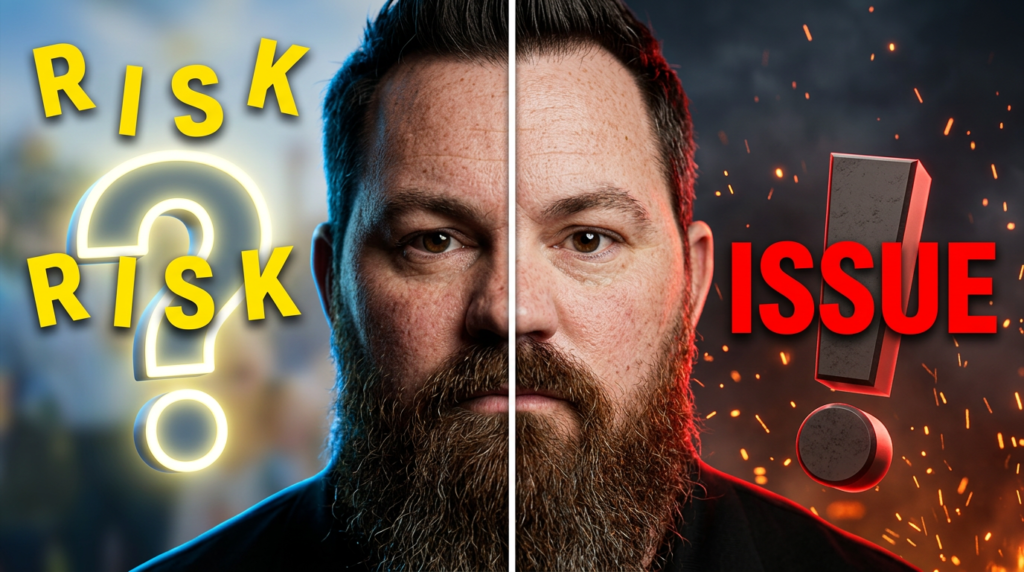
We characterize risk as uncertainty. It refers to a future event, positive or negative, that might affect project objectives. Risks are probabilistic: they carry a likelihood of occurrence and a potential impact. They belong in your risk register. They are managed proactively through identification, analysis, and planned response strategies including avoidance, mitigation, transfer, and acceptance.
An issue is a realized event. It has occurred. The uncertainty is resolved, the outcome is now a present reality the project must address. Issues belong in your issue log. They are managed reactively through impact assessment, workaround development, and escalation where necessary.
The governing risk vs. issue language test is straightforward: if you can attach the word ‘might’ or ‘could’ to the event, it remains a risk. If the event is in the past tense, if it has occurred or been discovered, it is an issue.
The Two Fatal Misclassification Errors
Error #1: Treating Issues as Risks
This is the more common mistake. An event occurs — a vendor misses a critical delivery date, a key resource departs, a budget line is cut — and the project manager responds by placing it on the risk register and noting they will ‘monitor and watch.’
The problem is structural: the risk management framework is designed for proactive, forward-looking response. It has no mechanism for resolving realized problems. When you monitor an issue as if it were a risk, you delay response, allow damage to escalate, and signal to your stakeholders that you are not equipped to manage current realities.
The appropriate response to an issue is execution: assess impact immediately, develop a workaround, assign ownership, and escalate to the appropriate decision-maker if the issue threatens project viability.
Error #2: Treating Risks as Issues
The opposite error is equally damaging and more visible. When a project manager identifies a risk (something that might happen) and escalates it to senior leadership as an active problem, the organizational response is swift: leadership examines the situation, determines nothing has happened, and concludes that the PM has poor judgment.
This ‘crying wolf’ pattern deteriorates stakeholder trust over time. Leadership begins to discount the PM’s assessments. When a genuine issue does emerge, the appropriate sense of urgency has been diluted.
Risks should be managed at the appropriate level of the risk hierarchy. Not every risk warrants senior leadership escalation. A clear risk threshold, defined in your risk management plan, should govern what rises to what level.
The Organizational Impact of Language Precision
In high-performing risk management cultures, language precision is not pedantry — it is a leadership tool. When teams consistently distinguish between risks and issues, three organizational benefits emerge:
- Escalation integrity: The right information reaches the right decision-makers at the right time. Leadership trusts the signal quality of risk communications because they have been calibrated correctly.
- Response efficiency: Teams know whether they are in proactive planning mode or reactive execution mode. Resources are allocated accordingly, and response timelines are appropriate to the urgency.
- Audit trail clarity: Risk registers and issue logs serve distinct documentation purposes. When the two artifacts are well-maintained, project post-mortems yield higher-quality lessons learned.
Implementation: The Language Audit
The most immediate application of this framework is a language audit of your current project documentation. Work through your risk register and apply this test to every item:
- Has this event already occurred? If yes: remove from risk register, create an issue log entry, assign a response owner, and determine escalation need.
- Does this event describe something that might occur? If yes: verify it has a clearly documented probability, impact rating, risk owner, and planned response. Confirm it belongs in the risk register.
- Is the language ambiguous? Rewrite the risk statement using the PMI recommended format: ‘Due to [cause], there is a risk that [event], which would result in [impact].’ This structure forces clarity.
Conduct this audit in your next team meeting. Ask of each item: ‘Has this happened yet?’ The answers will immediately surface misclassifications.
PMI Alignment: RMP and PMP Exam Context
For organizations whose risk managers and project managers hold or are pursuing PMI credentials, this distinction carries additional weight. Both the PMP and PMI-RMP exams test it directly.
Exam questions are constructed to reveal whether the candidate understands the correct management response based on classification. A question describing a realized event that presents answer choices including ‘monitor and watch’ is testing whether the candidate knows that monitoring is a proactive risk management activity, not an appropriate response to a confirmed issue.
Building this language discipline into your team’s day-to-day practice reinforces exam readiness at the same time it improves project outcomes.
Conclusion: Clarity in Risk vs. Issue Language Creates Clarity in Leadership
The distinction between risk vs. issue is not academic. It defines whether your team is proactively managing uncertainty or reactively fighting fires — and whether your stakeholders perceive you as a credible, precise risk leader.
Elite project risk leaders maintain this language discipline consistently: in status reports, in team meetings, in escalation conversations, and in their documentation artifacts. It is one of the simplest and highest-leverage habits in risk management practice.
Audit your risk register today. Correct the language. Assign response owners to what has already happened. Then watch how quickly your stakeholder credibility and team clarity improve.
Explore our PMI-RMP and PMP certification preparation cohorts — designed for risk professionals who want mastery, not just memorization: [Course CTA Link]
About 44Risk PM, LLC
This analysis was prepared by 44Risk PM LLC, specializing in PMI-RMP® and PMP® certification training with a focus on practical, real-world risk management.
Contact:
Russ Parker
PMP®, PMI-RMP®, PMI-ACP®
PMI-ATP Instructor – PMP® & PMI-RMP®
Owner, Forty-Four Risk PM, LLC
An Approved PMI-Authorized Training Partner
Connect with me on Linkedin
Subscribe to my YouTube
Find me on Substack
“Stay Proactive Over Reactive”
“The PMI-Authorized Training Partner seal, PMP®, PMI-RMP®, and PMI-ACP® are registered marks of the Project Management Institute, Inc.”