You’ve heard about the PMI-RMP certification. Maybe you’ve Googled it a few times. And now you’re stuck in that frustrating loop of conflicting information, unclear requirements, and one burning question: Is this thing actually worth my time and money?
Here’s the thing. I get asked about the RMP constantly—emails, LinkedIn messages, YouTube comments. And the questions are almost always the same ten. So instead of answering them one at a time, I’m laying it all out here.
I’m Russ Parker. I hold the PMI-RMP and PMP certifications, I’m a project manager in the financial sector, and I spent 20 years as a U.S. Marine Corps officer where risk management wasn’t just a process—it was the difference between mission success and failure. Now I run 44RiskPM, where I coach project managers through certification and help them actually become better at managing risk.
Let me tell you why risk management became my thing—and then we’ll tackle those ten questions.
Why I Take Risk Management Seriously...
Back when I was a lieutenant in the Marine Corps, I was preparing for a deployment to Afghanistan. I got tasked to support a rifle range and needed to develop an operational plan. I had about six weeks and a mountain of other responsibilities, so I did what seemed efficient: I called a buddy who’d run a similar range, grabbed his plan, did a quick find-and-replace with my unit’s name, and submitted it.
Done. Easy. Or so I thought.
A few days before the range, my lieutenant colonel called me into his office. If you’ve been in the military, you know that’s never a good sign.
He proceeded to tear me apart—and rightfully so.
The risk management section of my order was all about heat mitigation. Hydration. Recognizing heat exhaustion. Cooling procedures.
My range was running in December. In the middle of a cold snap.
I had submitted a plan with risk responses for the exact opposite conditions we’d face. And because I hadn’t written it myself, I couldn’t defend it. Worse, my commander now questioned whether I could lead my platoon of 30 Marines into combat in a few months.
That moment changed everything for me. Risk management couldn’t be a checkbox. It couldn’t be copy-paste. It was the foundation of keeping my people trained, prepared, and alive.
I ran that range successfully—with corrected risk planning. I took my platoon to Afghanistan. And I brought everyone home.
That lesson has shaped my entire career since. Mastering risk management is what separates good project managers from great project leaders. And it’s more accessible than you think.
Now let’s get into your questions.
Is the PMI-RMP Certification Worth It?
This is the question I get more than any other. And my honest answer: yes, but the real answer depends on what “worth it” means to you.
If you’re focused purely on salary, your ROI will depend on your industry and your organization’s risk maturity. High-stakes sectors like defense, pharmaceuticals, construction, and energy value risk expertise more than others. In those environments, the RMP can absolutely translate to salary bumps and senior roles.
But for most people, the RMP isn’t really about immediate dollars. It’s about becoming the person who sees problems before they blow up. The one whose judgment the team trusts. The project manager who leads with clarity instead of guesswork.
Here’s what’s changed recently: In PMBOK 8, risk management was elevated to its own performance domain. It’s no longer buried in the knowledge areas—it’s front and center as a core discipline. That’s the industry telling us risk matters more than ever.
The investment is reasonable: $520–$670 for the exam depending on PMI membership, plus training costs. Compare that to an MBA or years of trial-and-error learning, and the RMP fast-tracks real competence.
For a deeper look at why risk expertise is becoming essential, read: Why the PMI-RMP® Certification Is the Strategic Edge Project Managers Need in 2026
What are the Eligibility Requirements for the PMI-RMP Certification?
This trips people up because there are three paths—and they’re different from the PMP.
| Path | Education | Risk Management Experience | Risk Management Education |
|---|---|---|---|
| A | High School or Associate’s | 36 months | 40 hours |
| B | Bachelor’s Degree | 24 months | 30 hours |
| C | GAC-Accredited Program | 12 months | 30 hours |
Read more on the eligibility requirements: PMI-RMP Eligibility Requirements

Critical Details Too Many People Miss
Experience must be risk-specific. You can’t count general project management hours. If you ran a six-month project, you can only count the time you were actually doing risk management work—identifying risks, running analysis, developing responses, monitoring.
Education must be risk-specific too. That 35-hour PMP prep course you took? You can only count the portion that covered risk management (usually 2-3 hours). You need dedicated risk management training.
Experience must be within the last five years. Unlike the PMP, there’s a recency requirement.
If you don’t have a four-year degree, note that you need 40 contact hours of education instead of 30. Plan accordingly.
How Hard is the PMI-RMP Exam?
Let me be direct: it’s harder than most people expect. In fact, most RMP holders I’ve talked to—myself included—say it’s harder than the PMP.
Why? The RMP has a narrower focus, which means they go deep. The exam is 115 questions in 2.5 hours. That’s 65 fewer questions than the PMP and 80 fewer minutes. But every single question hits risk management from some angle.
The PMP spreads across all of project management, so risk might come up in a handful of questions. The RMP is 115 questions of nothing but risk—threats, opportunities, quantitative analysis, stakeholder engagement, risk culture, Monte Carlo simulation, expected monetary value. They test it all.
This isn’t a memorization exam. It tests whether you can think like a risk leader under pressure. Whether you can apply concepts to messy, real-world scenarios.
I’m not saying this to scare you. I’m saying it so you take it seriously. One of my students just passed last week, and she’d tell you the same thing: prepare properly and it’s absolutely doable. Underestimate it and you’re in trouble.
Why Should I Study
This is where the RMP differs significantly from the PMP.
Start with the PMI-RMP Exam Content Outline (ECO). This document is your roadmap. Unlike the PMP where you can get by without diving deep into the ECO, the RMP demands you understand every line. If you can’t explain what “creating a culture of risk awareness” means or how to “conduct stakeholder analysis” in a risk context, you’re not ready.
For a complete breakdown, read: PMI-RMP Exam Content Outline (ECO) Explained
Core Reference Material
- PMI Practice Standard for Risk Management (Project/Program/Portfolio)
- PMBOK Guide (6th, 7th, or 8th edition)
Recommended Book (These Matter for the RMP)
- Project Risk Management: The ATOM Methodology by David Hillson and Peter Simon
- Identifying and Managing Project Risk by Tom Kendrick
Unlike the PMP, these books aren’t optional nice-to-haves. They influence the exam. I wish I’d read them before my first attempt. And fair warning—don’t try the audiobook versions. These require actual reading with a highlighter.
Here’s something I’ll be honest about: the quality of RMP study materials out there is inconsistent at best. I’ve taken six different RMP prep courses over the past three years searching for the best information. Most were outdated, poorly structured, or not aligned to the current ECO. That’s exactly why I built my own course using PMI’s ATP materials—because the organization that writes the exam has the most accurate content.
Should I Get the PMP or PMI-RMP Certification First?
You don’t need the PMP to take the RMP. But here’s the reality: the RMP assumes you understand project management fundamentals.
The Exam Content Outline includes tasks like “conduct stakeholder analysis” and “align risk management with organizational objectives.” These aren’t pure risk topics—they require foundational PM knowledge.
If you don’t have the PMP, the RMP will be eye-opening in ways that might slow you down. You’ll be learning project management basics while trying to master risk specialization.
If you have the PMP, the RMP becomes a natural next step. You already understand the framework. Now you’re going deeper into one critical area.
My recommendation: PMP first, then RMP. But if you have extensive project experience and solid PM fundamentals through other means, you can make the RMP work.
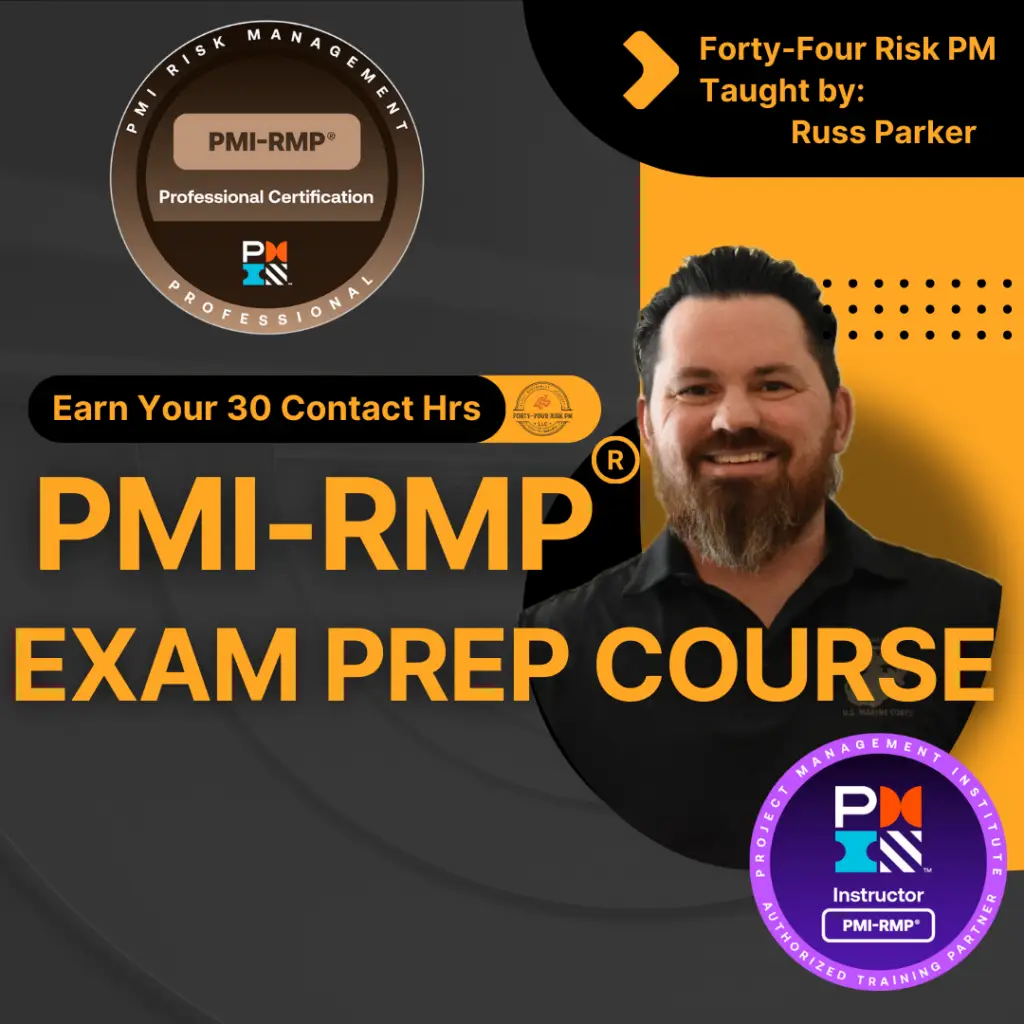
Inside the Course:
A proven study system aligned with the RMP exam content outline
Step-by-step video training + downloadable tools
Practice exams and exam strategy
Built-in accountability + community support
Access to the Pathway to the RMP™ if you’re just getting started
How Long Should I Study?
This depends heavily on your background.
If you have the PMP: Plan for 4-8 weeks with 60-80 hours of focused study. About an hour to an hour and a half daily.
If you don’t have the PMP: Plan for 8-12 weeks with 100-120+ hours. You’ll need extra time to build foundational knowledge alongside the risk specialization needed for the PMI-RMP Certification.
The key word is focused. This isn’t background studying while you half-watch TV. Engage with the material. Work through practice questions. Review the ECO line by line.
What's Actually on the Exam?
The exam covers five domains, weighted like this:
| Domain | % of Exam |
|---|---|
| Risk Strategy and Planning | 22% |
| Risk Identification | 23% |
| Risk Analysis (Qualitative + Quantitative) | 23% |
| Risk Response | 13% |
| Monitor and Close Risks | 19% |
Notice that Risk Analysis—which includes quantitative methods like Monte Carlo simulation and EMV—makes up nearly a quarter of the exam. This is where a lot of candidates struggle because the PMP barely touches quantitative analysis.
Also note: the domains aren’t purely technical. Domain 1 includes stakeholder engagement and building risk culture. If you think the RMP is just about probability and impact matrices, you’ll be caught off guard.
Your study roadmap: PMI-RMP Exam Content Outline (ECO) Explained
Can I Take the Exam Online?
Yes. You have two options, same as the PMP:
Testing center: Traditional proctored environment during business hours.
Online proctored: Take it from home, available 24/7.
I personally only take these exams at testing centers. Fewer variables, controlled environment, no risk of technical issues or distractions. But I know plenty of people who’ve passed online without problems.
Choose what works for your situation—just make sure your home setup meets PMI’s requirements if you go that route.
What are the Best Practice Exams?
Practice questions are crucial. You need to get comfortable with how PMI frames scenarios and what they’re really asking.
My top recommendations:
PMI Study Hall ($49): One full exam, three mini exams, and daily quiz emails. The questions are PMI-quality because they’re from PMI. I still use the daily quizzes to stay sharp.
Pocket Prep ($17-21/month): Easier questions, good for building confidence early. Start here, then graduate to Study Hall.
PMI’s $99 Practice Exam: Additional full-length exam if you want more reps.
Critical warning: Make sure any practice exams you use are aligned to the 2022 Exam Content Outline. I’ve seen plenty of question banks floating around that use outdated content. If the questions don’t match the current ECO, they’re hurting more than helping.
My RMP Exam Prep Course includes a practice exam, and the RMP Prep Lab Community has multiple exams and quizzes—all aligned to the current ECO.
How Do I Maintain the PMI-RMP Certification?
First, focus on passing. But here’s what comes after:
30 PDUs every three years. That’s half of what the PMP requires.
The breakdown: 18 education PDUs and 12 “giving back” PDUs. All activities must be risk management-focused.
You can earn PDUs through:
- PMI chapter meetings and events
- Online courses and webinars
- Writing articles or creating content
- Teaching or mentoring others
- Volunteer work in risk management
It’s manageable. Keep engaging with risk management topics and you’ll accumulate PDUs naturally.
Your Next Step....
The PMI-RMP isn’t just another line on your resume. It’s a signal to your organization and your industry: this project manager doesn’t just react to chaos—they manage it proactively.
If you’ve read this far, you’re not casually curious. You’re seriously considering whether this certification fits your career.
Here’s what I know: every project has risk. Most project managers handle it reactively—or avoid it entirely. The ones who build systematic risk competence become invaluable. They’re the leaders organizations trust with high-stakes initiatives.
The RMP is how you get there.
→ See Upcoming PMI-RMP Exam Prep Courses
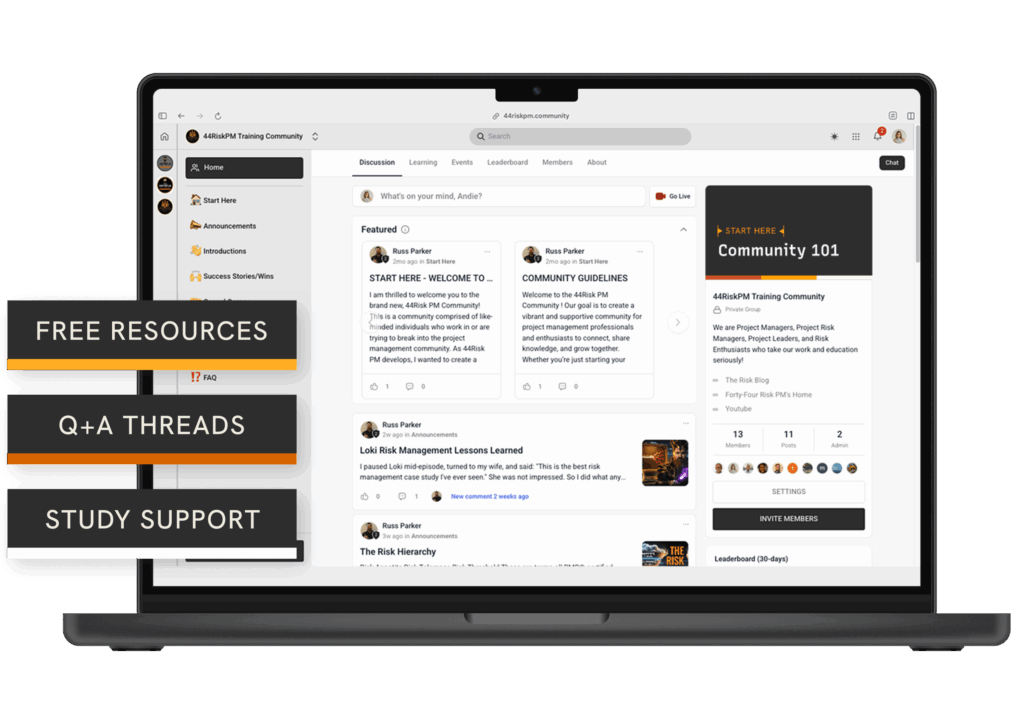
→ Join the RMP Prep Lab Community — Start connecting with resources and other candidates today.
Have a question I didn’t cover? Drop it in the comments or reach out on LinkedIn. I answer everything.