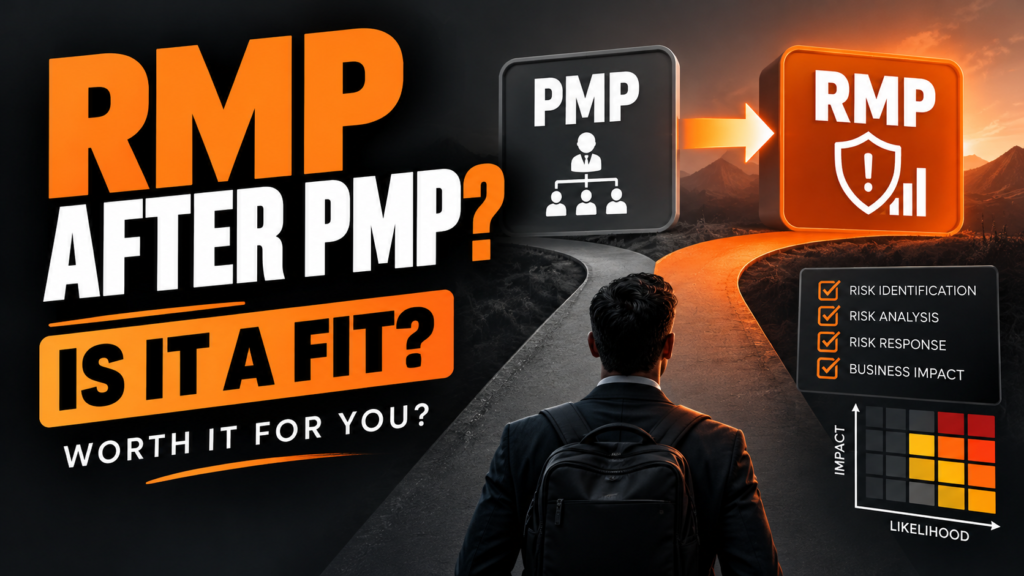
Picture the steering committee. Three red risks on your matrix, a CFO asking which one gets the money, and a sponsor staring right at you waiting for a call. You passed the PMP®. You know the vocabulary cold. And right now, none of it is telling you what to say next.
I teach both the PMP® and PMI-RMP® exam prep courses, so I have this conversation with PMP® holders all the time. The PMP® gives you risk vocabulary and a high-level view of the process. It does not give you the judgment to use it when a project goes sideways.
Just in my last PMI-RMP® Exam Prep Course, a student told me they were taking the course and putting a focus in risk management. This all stems from an occurrence with her new boss at a new job she got after earning her PMP®. She arrived and immediately got assigned an internal project for developing their risk management processes and tools. Initially, she said she froze. Realizing the PMP® did not prep her for this work.
That space between knowing the process and exercising judgment is what I call the judgment gap: the place where good PMs stall and great ones get promoted. This guide helps you figure out whether RMP prep is the right way for you to close it.
In this post
- Why Fit Beats “Is It Worth It” for PMI-RMP Prep
- Who PMI-RMP Prep Fits Best After the PMP
- Who Should Hold Off on RMP Prep for Now
- The Five-Skill RMP Fit Test: Decide in Five Minutes
- FAQ: PMI-RMP Prep After the PMP
Why Fit Beats “Is It Worth It” for PMI-RMP Prep
Fit decides whether PMI-RMP prep pays off, not some universal “worth it” verdict. The certification earns its keep for PMP holders whose jobs already demand risk judgment they were never trained to use. It’s a waste for anyone hoping a second credential will do the work the first one didn’t.
Ask “is the PMI-RMP worth it” in any project management forum and you get the same answer on repeat: it depends. Somebody points out that risk is already a knowledge area in the PMP. Somebody else says a certification is only worth it if employers ask for it. Then the thread dies, and you’re no closer to a decision. “It depends” is true. It’s also useless unless someone tells you what it depends on.
So here’s what it depends on. Passing the PMP proves you know the process. It’s a big exam covering a huge amount of material, which is exactly why PMI built specializations like the PMI-RMP® and PMI-SP® on top of it. The PMP checks whether you can recognize the right risk answer in a multiple-choice question. Your job checks whether you can walk into a steering committee and get a decision made.

The real question isn’t whether the RMP is a good certification. It’s whether your role is already asking you to do things the PMP never trained you to do. If it is, you have a fit problem the RMP solves. If it isn’t, no credential changes that, and you’re better off building experience first.
That reframe matters because wrong-fit buyers are the ones who end up calling certifications worthless. They bought a credential to fix a career problem it was never built to fix. Right-fit buyers buy it to close a skill gap they already feel every week at work, and they walk out using it on Monday.
Who PMI-RMP Prep Fits Best After the PM
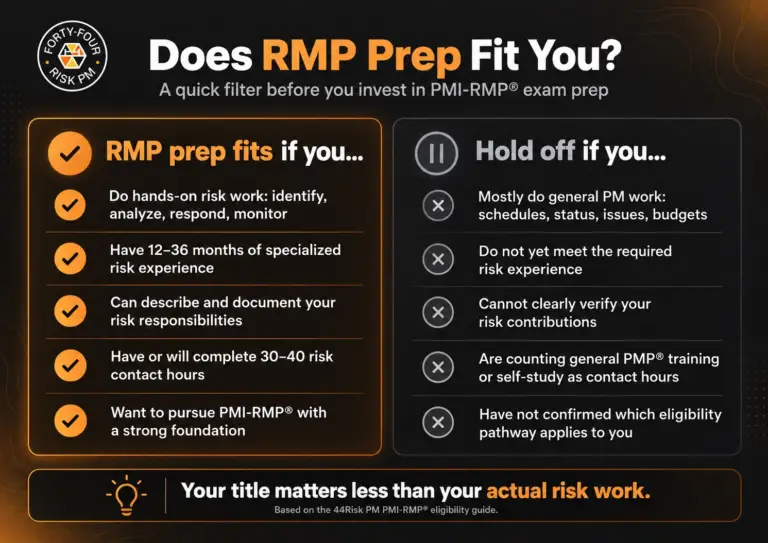
PMI-RMP® prep fits PMP® holders who already carry risk decisions at work and keep feeling under-equipped for them. Title doesn’t matter here. Situation does. If two or more of these profiles describe your current role, you’re the person the course was built for.
- The PM whose risk reports get nodded at and ignored. The risks are in your weekly status report and nothing moves. You need to turn “there’s a 40% chance the vendor slips” into “there’s a 40% chance the vendor slips in two weeks, that’s roughly $80,000 in penalties, and I need a decision on the backup supplier by Thursday.”
- The PM running risk register theater. That’s a register that looks healthy while the project is quietly on fire. The real risks (the vendor everyone distrusts, the sponsor who keeps moving scope) live in hallway conversations and never make it onto paper.
- The PM making calls with thin data. Your probability and impact matrix hands you three reds and no clear winner, and the sponsor wants an answer today.
- The PM in a regulated or high-stakes industry. Wrong estimates carry real consequences on your projects, and leadership expects risk numbers, not color codes.
- The PM who wants to be the risk SME. You want to be the person the room listens to when things go sideways, not just the person who maintains the spreadsheet.
In my RMP cohorts, the most common student is a PMP® holder a few years into the job who just got handed a bigger, riskier project and realized the matrix alone was not going to carry them.
The PMI-RMP® Exam Prep Course is built around that reality. It’s aligned to all five PMI-RMP® domains, taught live in small groups with real access to me, and it covers the 30 contact hours you need to apply. The goal is exam ready and job ready at the same time.
Who Should Hold Off on RMP Prep for Now
Hold off on RMP prep if you don’t have specialized project risk experience yet, if you’re still working toward the PMP, or if you want a credential to stand in for doing risk work. The RMP rewards people already doing the job. It doesn’t create the job for you.
- You haven’t logged specialized risk experience yet. PMI wants hands-on risk work, not general project work with a risk register attached. With a four-year degree, that’s 24 months of project risk experience in the last five years plus 30 contact hours. With a secondary diploma, it’s 36 months plus 40 hours. If you strip the word “risk” out of your experience and it still reads like normal project management, it probably won’t qualify.
- You’re still studying for the PMP. Finish that first. The PMP gets you in the room. The RMP is the specialization you stack on top of it.
- You want the letters, not the skills. If the goal is a resume line and you have no plans to lead risk conversations, the course will feel like work you didn’t sign up for.
- Nobody expects you to own risk decisions. If risk ownership isn’t part of your role now or on the horizon, get that exposure first.
I regularly tell people on intro calls to wait a few more months. Usually their experience is solid project work but not yet specialized risk work, and I would rather they apply once and pass an audit than rush and get sent back.
But this hasn’t stopped many of them from taking the Prep Course now… they learn the skills to put into action, gain the experience, and build their application simultaneously.
I break down exactly what counts for experience, what doesn’t, and everything you need to know about PMI-RMP® Eligibility Requirements in This Article.
Waiting isn’t failing. It’s sequencing. PMP first, RMP second is a deliberate career move, and taking the steps in order is how you make the second one count. If you’re in the hold-off group today, the right move is to start collecting the experience now so your application practically writes itself when you’re ready.
The Five-Skill RMP Fit Test: Decide in Five Minutes
The fastest way to decide on RMP prep is to score yourself on the five risk skills employers actually pay for and the PMP barely touches. For each skill, answer two questions honestly: does my job demand this, and can I do it well today?
Every “my job demands it, but I can’t do it yet” earns one point.
- Framing risk as a decision executives can act on. Can you run every risk through “so what” (the business impact in dollars, dates, or scope) and “now what” (the decision you’re asking for)? Reporting a risk and framing a decision are two different jobs, and executives only respond to the second.
- Building a team where bad news surfaces. Can you get the quiet people to tell you the risks they’d never say in front of the boss? Test it at your next session with anonymous-first identification: everyone privately submits their top three risks before anyone speaks.
- Making judgment calls under uncertainty. When the matrix gives you three reds, can you state your confidence level, weigh the cost of being wrong against the cost of waiting, and pick the smallest reversible step?
- Spotting and countering bias. Can you catch optimism bias, the planning fallacy, anchoring, and groupthink in your own estimates? Bent Flyvbjerg, who studies why megaprojects fail, separates power bias (rooted in office politics) from cognitive bias (rooted in psychology), which matters when the most senior person in the room is also the most confident.
-
Running quantitative analysis, not just naming it.Can you turn “this project will cost $500,000” into “there’s a 70% chance we come in under $550,000 and a 10% chance we blow past $600,000”? That second sentence comes from a different professional. I went deeper on the methods in How to Master Risk Quantitative Analysis Techniques.
Score it and take your door:
- 0 to 1 points: not yet. Your role isn’t demanding these skills right now. Start with the free RMP training and re-run this test when your role changes.
- 2 to 5 points and eligible: you’re a fit. Grab a seat in the next small-group cohort of the PMI-RMP® Exam Prep Course.
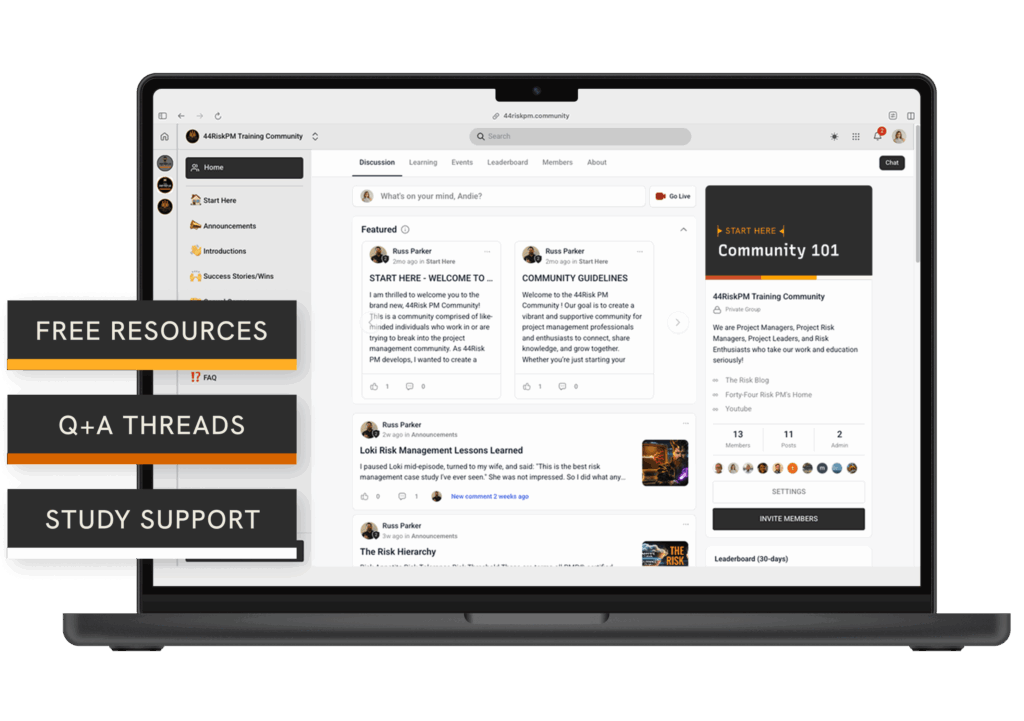
- Already have your 30 contact hours and studying: you need support, not another course. Get structure, live Q&A, and someone checking your thinking inside the RMP® Prep Lab.
Borderline? If you scored two or more but you’re a few months short on experience, take the free training now and book the cohort that lines up with the month you qualify. The process is what gets you certified. Judgment is what gets you hired.
FAQ: PMI-RMP Prep After the PMP
What if I’m borderline on PMI-RMP fit?
If you’re borderline, look at your next twelve months, not your last twelve. Focus on getting a riskier project, a bigger budget, or a risk-owner role… This ensures you fit. If your experience is short, take the free RMP training now and line up a cohort for the month you qualify.
Does PMI-RMP fit change as my career grows?
Yes. Fit follows responsibility. A PM who doesn’t own risk decisions today often does after the next promotion or the next high-stakes project. Re-run the five-skill test whenever your role changes, especially once you start presenting to steering committees or defending contingency reserves.
What’s the most common way PMP holders misjudge RMP fit?
They assume the PMP already covered risk. It covered the vocabulary and the process. The usual misjudgment is confusing recognizing the right answer on an exam with making the call on a live project, where the data is thin and a sponsor is waiting on you.
What should I check before deciding on PMI-RMP prep?
Check three things: your specialized risk experience in the last five years, your contact hours, and whether your role demands the five skills. With a four-year degree, PMI requires 24 months of risk experience and 30 contact hours. If those line up, you’re ready to pick a cohort.